“Is it just me, or is it getting crazier out there?”
We see a man named Arthur Fleck struggling with a mental illness that towers over his life; shadows spill over everything he sees and thinks, coating his reality in an oppressive darkness. He attends recurring appointments with a public service worker and takes seven different types of medication, all while enduring a level of coarse, wholesale rejection from society which exacerbates his negative thought patterns and renders any pathway to recovery so elusive that the idea altogether begins to fade into imperceptibility. One day, after Arthur endures a particularly senseless and traumatic act of violence, a coworker gives him a gun.
With this, the stage is set for Todd Phillips’ “Joker,” the apparent *it* movie of early fall (but not the “It” movie; that was something else). After taking the Venice Film Festival by storm (winning its highest prize, the Golden Lion) and stirring up a polarized vortex of passionate takes from critics, it’s now found its way to theaters and the public at-large is finally able to experience firsthand its relentlessly bleak take on what ails society, refracted through the lens of DC Comics’ most iconic villain.
Except, set against a disinterested, patchwork backdrop of political and cultural motifs, “Joker” doesn’t really have a take. More on that shortly.
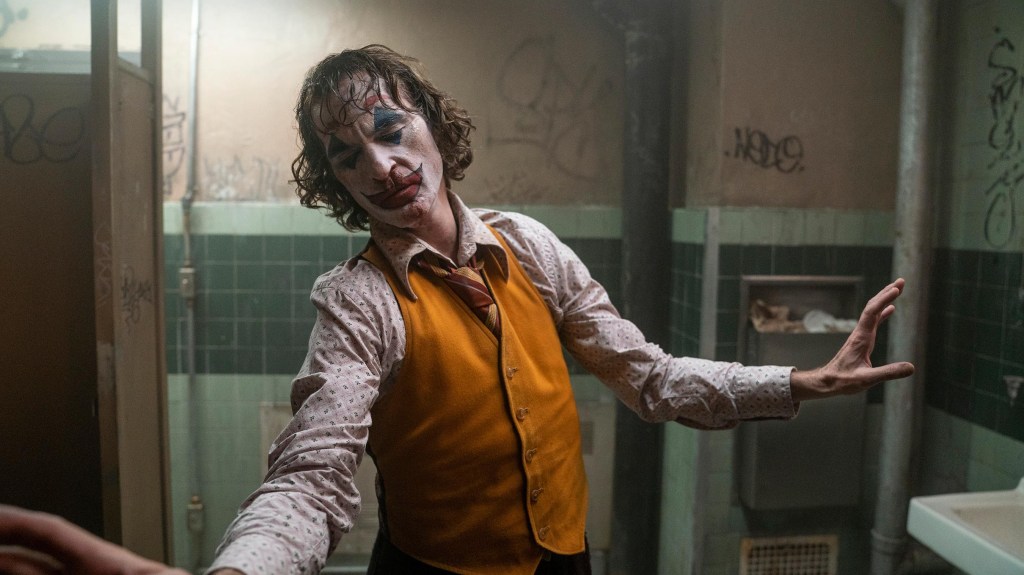
First, the good! Joaquin Phoenix’s much-heralded performance is as strong as advertised; he brings a level of nuance to the role that feels out of place next to the rest of the movie, at times elevating it beyond its script which does little more than prompt characters to say the next thing that will advance the plot. The movie’s aesthetic is, for the most part, immensely well-crafted and convincing. Lawrence Sher’s photography externalizes Arthur’s dour personal circumstances without letting its fairly distinctive color palette be washed out amid the gloom. Even the direction has its moments, as there are a handful of truly gripping scenes that combine clever blocking, lighting, and editing (Jeff Groth) en route to some electrifyingly chilling moments.
Ultimately, however, the film seems to be stubbornly opposed to actually grappling with any of its thematic material; in fact, I don’t think that it successfully manages to string anything together into an actual theme. One of the basest requirements of crafting social commentary is having something to say, but “Joker” instead opts to point at things while grimly shaking its head as if to murmur, “Hmmm… that’s not good.” Admittedly, sometimes this approach yields coherence, like when Arthur discovers that the office he visits for counseling is shutting down due to financial cutbacks. We can infer that some combination of cynicism, ignorance, and malice led elected officials to decide that mental health care was on the budgetary bubble, and we see the direct impact that these decisions can have on people that rely greatly on such public channels.
However, when this mood of vague condemnation turns its gaze more explicitly on macro-level forces such as economic inequality and civil protests, the result is—to be generous—contradictory and inscrutable.
In the world of “Joker,” the seeds of discord have already been sown. (“Madness is like gravity,” we hear echo from Christopher Nolan’s “The Dark Knight,” “—all it takes is a little push.”) Public blood-thirst is stoked by a set of shocking, brutal killings on the subway and fueled by a mayoral candidate’s crass comments which write-off a substantial portion of the population as “clowns.” Masses begin to rally, wielding signs displaying iconography exaggerated just beyond a parallelism to contemporary demonstrations (at one point we see a “RESIST” sign). By wedding legitimate movements against injustice with violent, clown-mask-donning reactionaries, demonstrated dissent against the status quo is itself painted as irrationally-scaled and wildly temperamental. Note that this is the same status quo we just saw squeeze a man into desperation by severing his most important lifeline.
We’re given a solemn head-shake to every side of every issue.
Society, man.
This brand of chaotic, dismissive nihilism is exhausting and all-the-more absurd next to repeated narrative sojourns into slightly more conventional comic-fare (of course Arthur meets Bruce Wayne; the best version of this film does away completely with these fifteen not-actually-obligatory minutes). When all is said and done, after witnessing Arthur Fleck descend into an evil, dangerous madness while writhing through a vast, cynically-concocted malaise of social-ills, what are we to think when Phoenix’s Joker at last emerges from the flames, now fully recognizable as Gotham’s infamous villain?
“Hmmm… that is NOT good.”
Grade: C-
“Joker” is in theaters now.


 On the Image
Leave a reply to Zach Cancel reply