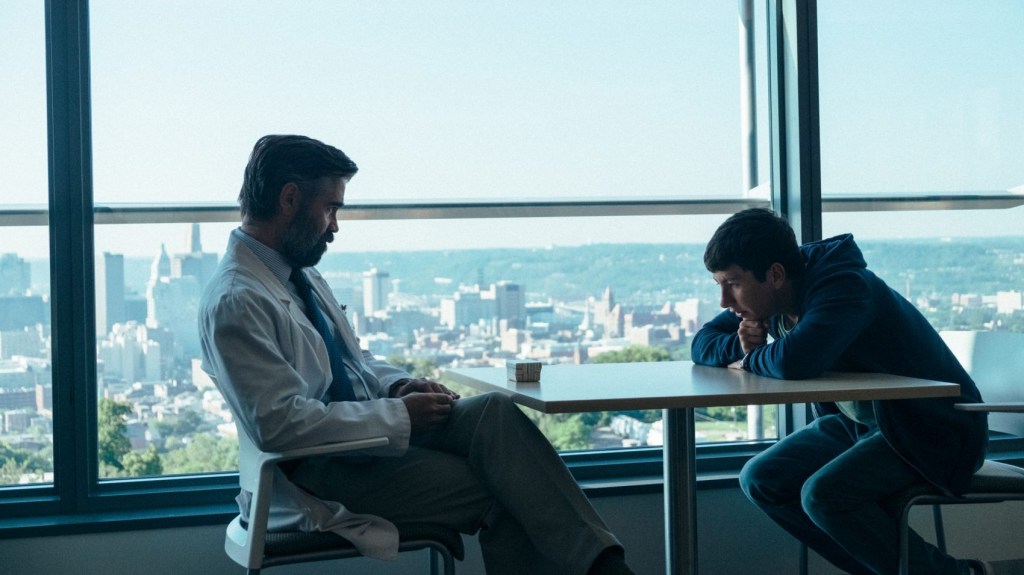
“A surgeon never kills a patient.”
You sit on the edge of your seat in a waiting area outside of an operating room. Externally, everything is still but for an erratically quivering fluorescent light above you, pattering wearingly against your eyes and ears. You’re looking towards the floor, with your elbows perched uncomfortably above your knees and your fingers interlocked over the back of your neck. Internally, an ambiguous terror eats away at you. You’re scared and you don’t know why. Or maybe you’re scared because you don’t know why. Does that even make sense?
“This is hell,” you decide with an alarmingly steadfast resolution.
After an indistinct but substantial amount of time, you look up. Your surroundings appear unnaturally tidy and symmetrical, as though they were arranged specifically for aesthetic compatibility with your personal field of vision. This strikes you as a strange observation for a number of reasons, not the least of which being that you just never really notice this kind of thing. Before you can follow this tangent, you hear a door swing open to your right and you turn your head, subsequently reframing the room into a new, more dynamic image. You briefly allow yourself to be quietly impressed by your newfound eye for composition. The surgeon enters the waiting area through the open door, surveys the scene, and makes several swift strides in your direction, though he stops far enough away that you suddenly question whether or not you were the target of his focus. You stand and prepare to speak, thinking that you’re finally with somebody who might have his finger on the pulse of the vague dread filling the room. However, before you can open your mouth, he fires off a question about your watch.
“My watch?” The words whizzed by your left ear.
“What’s the make? The size? It looks like a 42mm but I can’t tell from here. What about the strap? I have metal links but I know that some people prefer leather. Is it waterproof? To what depth?”
These questions that may range from cursory to droll in another setting are coming across as unnervingly blind to the context of your situation and stunningly nonchalant about the norms they’re disregarding. Questions of your own that had been simmering inside your mind have now begun to boil. Why is the room around you starting to shake? Why are you beginning to feel like you’re the one whose behavior is ill-befitting of this conversation? Why does this surgeon look so much like Colin Farrell?
These questions give voice to the almost-tangible friction created by the collision of two worlds: that of our physical reality and that which exists in the mind and films of Yorgos Lanthimos. His latest picture, “The Killing of a Sacred Deer,” shows us a world in which it’s immediately clear that something is missing, and, chillingly, it’s equally clear that something else has taken its place. The film drops the viewer into environments that resemble ours, filled with people that resemble us, and, if paused on any single frame, this illusion of similarity could persist. However, Lanthimos’s demons live in montage, as if they themselves stem from the film’s inherent properties as an artistic medium; as the film comes to life, so do they.
These are forces that parasitically feed off of precision and order, that thrive in the devolution of progress, and that cling to old-testament sensibilities of supernaturally imposed justice. Their presence is felt within the film’s narrative, as Steven Murphy, played by Colin Farrell, is subjected to trials that cannot be combated by the knowledge and experience garnered throughout his career as a surgeon. He is told plainly what he must do to put an end to the pain, but the horrific irrationality of the answer casts him into a fit of denial. He rages vainly against the confines of his situation, an exercise that proves to be painstakingly torturous in its own right. By the time he collapses into a state of dejected acceptance, his unimaginably crude execution of the solution contrasts starkly with the rigorous discipline inherent to his professional life.
Bringing to light the parallels that exist between surgeons and filmmakers, Lanthimos spends much of the picture impressively flexing his conquest of form. For much of the movie, I didn’t know what was disconcerting about the images on screen, only that I was becoming increasingly uneasy with each passing moment. Elements of Kubrick’s “The Shining” echo within the borders of each frame, as Lanthimos brandishes a type of terror that has roots in the uncanny, initially relying on the viewer’s familiarity with the film’s environment to foster expectations. He then subverts these expectations by exposing that the foundations upon which they were built were never more than assumptions made by the viewer. You naturally fill-in the negative space that Lanthimos has carved into the world with your own understanding of reality outside the film. When Lanthimos methodically reveals the puzzle pieces that actually fit into these slots, the resulting fear feels very much like it’s coming from inside the house. You overreach with your assumptions, and then you pay for it.
An immutable theme of the film is the inevitable and exacting punishment of those that play god. In the case of Steven Murphy, we see a man who is in the business of life and death, but one that shuns the responsibilities and consequences that the business entails. His existence of definition and clarity devolves into a morass of physical and emotional confusion. However, that’s not all, as the parallels between the roles of Murphy and Lanthimos grow more robust. In the latter, we have an entity who has constructed a reality that runs parallel to our own, one that subjects his characters to unspeakable torment. The static, sterile, and impersonal portraits that define the film’s first act deteriorate into intimate, frantic, and tragically subjective imagery. He falls and ultimately shares in the pain of his character, restoring a perverted sense of justice to his world.
Grade: A
 On the Image
Leave a reply to The 91st Academy Awards: A Walk-Through – The Intangibles Film Blog Cancel reply