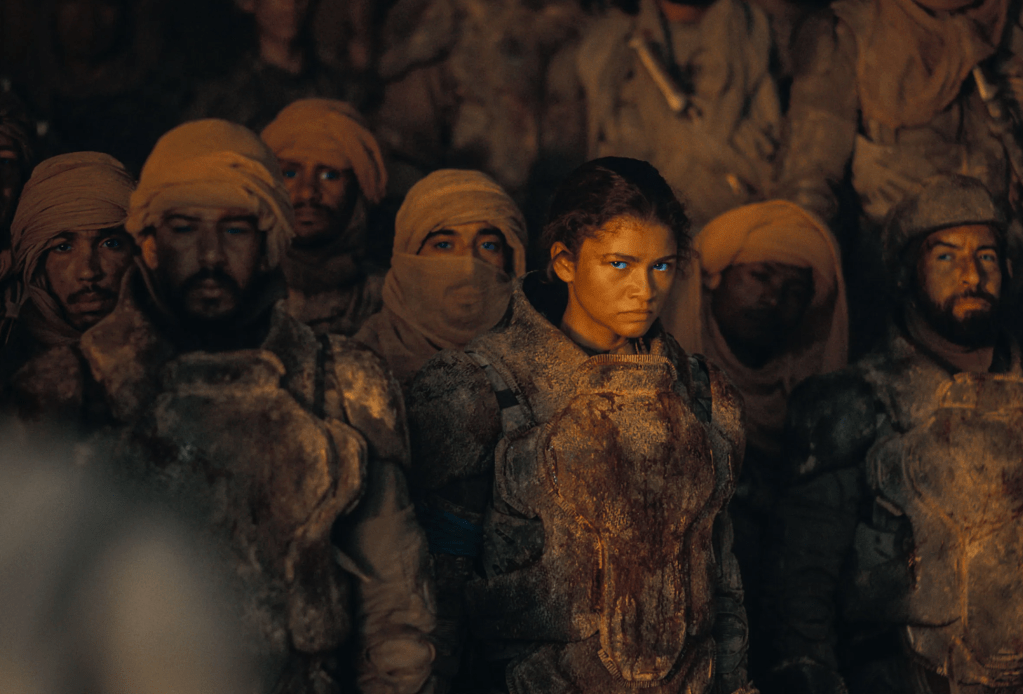
In DUNE (2021) director Denis Villeneuve displays a methodical patience, demonstrating a knowledge that his decisions don’t necessarily need to serve the ends of one film, but the needs of its successor. The resulting picture is deliberate, plotting, and impressive, if not altogether the most riveting experience for a viewer. He bores space into the frame, yielding cavernous tableaus that seem to extend without limit but are occupied primarily by characters entering into shot / reverse-shot dialogues, loosing a sea of expositional spores into the air and getting away with it because his vessels are all bona fide movie stars and could ensnare an audience with a phonebook.
This is not a criticism, by the way: casting is hard. A script getting away with a certain roteness of spoken word because of a talented ensemble is like saying a film only looks good because it was shot by a visionary cinematographer. Like… yeah. Yes.
That’s also not to say that the first film forfeits its opportunities for bombast, but even those sequences (thinking primarily of the worm-attack on the harvester and the Harkonnen invasion) can’t help but feel like firsts of two-step sequences. We’re watching set-ups, the knowledge of which is the vice inherent to any work which proactively claims the mantle of “Part One.”
DUNE: PART TWO (2024) is different.
It paints with populations, filling the spaces established by its predecessor with bodies. “Scale” is the word most vital to the picture on a technical level, and, although it’s an easy one to throw around when things are big, the concept is something that’s intrigued Villeneuve through his career—think of the spider in ENEMY (2013), the invasion in ARRIVAL (2016), and the AI hologram in BLADE RUNNER 2049 (2017). With this series he’s sought to make something that enters our world through the screen and similarly towers over us.
It’s barely an exaggeration to say that all of the picture’s components are calibrated towards the aim of instilling awe in the viewer, constructing a direct bridge to the experiences of its subjects. Hans Zimmer’s soundtrack is designed to be felt, and I mean that in the physical sense as much or more than I do the emotional one. Its bass textures grind and churn themselves into and out of a spectrum of forms, inhabiting both the frequencies of Shai-Hulud as they tear through the earth and the malicious combustion of the Harkonnen engines. It’s sensorially diegetic—the characters may not be hearing the notes but they’re feeling the same impacts.
Everything in the film is corporeal and imbued with mass; bodies fall to the ground with weighty thuds and ships sink from the sky with a sense of inevitability. Everything of substance is returned to the sands as if by natural law. This expectation lays the groundwork for a… specific vein of physical defiance.
Floating. I’m talking about the floating guys.
I mean this more as praise than I do condemnation, but I do actually mean it at least a little as condemnation (let me explain): the most spiritual thing about this movie is how it sometimes lets people float around with the effortlessness of a mouse cursor moving across the screen. After so clearly defining how objects behave through repeated tactile demonstration, creating pattern breaks allows the observing mind and spirit to be jarred. The opening combat sequence contains a moment where a heavily armored battalion of foot soldiers floats up a mountain-face in an arresting synchrony, and I think more than any other frame of the film this creates a sense of truly mythic wonder.
So, what’s the problem? Simply put, for a movie that is literally about fostering a cult-like belief in prophecy, it’s probably not functionally ideal that the most striking, memorable, ‘out-there’ imagery is Harkonnen levitation technology. It makes sense, though. For as fantastical as DUNE: PART TWO certainly is, it’s also quite literal, and I don’t know that Villeneuve has yet found his own approach to depicting the ethereal. Of course his moments of surreality stem from the physical rather than the abstract. It’s not necessarily wrong, but it begins to explain why much of the potential for brain-teasing weirdness is papered over with voiceover and dream imagery that is too lucid and coherent to be dreamlike.
Similarly, to the degree that these concepts are severable, Villeneuve’s command of physical space is consistently more effective than his command of temporal space. Despite all of my praise for the film’s physicality, that strength (unimpeachable in its own right) was often betrayed by cavalier cuts which would sweep our focus indistinctly forward and leave us feeling unmoored, if only briefly. As poetic as it might seem, I can’t bring myself to view this uncontrolled cadencing as akin to the feature’s deceptively deliberate sandwalk—it just feels a bit messy. The lead-up to the final conflict is perhaps the most illuminative instance of this phenomenon: without expounding too much, we see execution where we instead expect preparation. Crazy as it might sound, DUNE: PART TWO needed to be either longer or differently assembled.
Final note: these films are an absolute monument to production design, to the point that the striking nature of their imagery owes more to concept art than to frame composition. They almost play like a formal, if decades-late, follow-up to the Star Wars prequels, creating a fascinating sci-fi ouroboros.
Grade: A-
 On the Image
Leave a comment