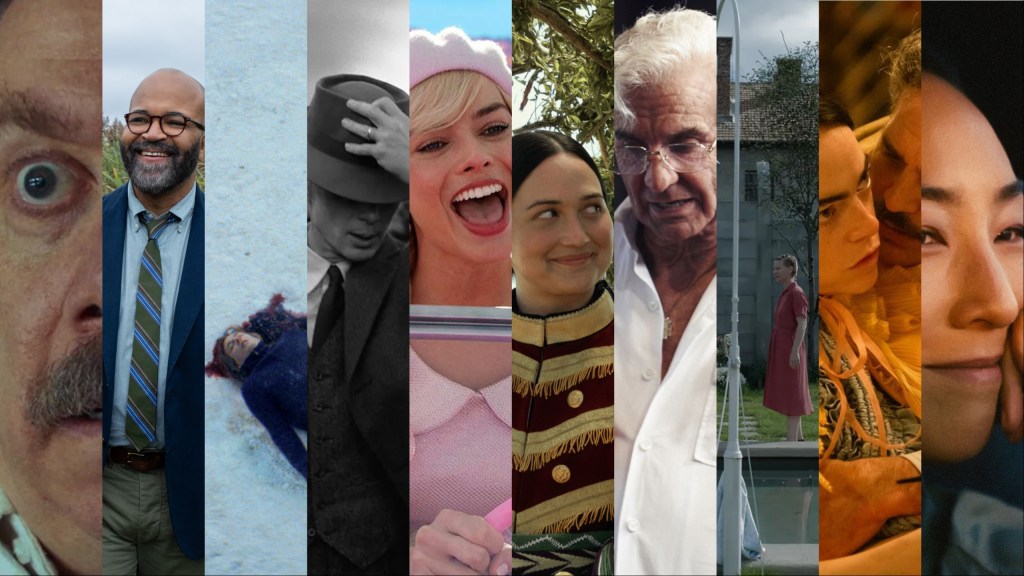
It’s Oscar weekend!
When I’ve written these walk-throughs in the past, I’ve tended to tackle one nominated field at a time, and while that’s largely intuitive when discussing an awards show, I don’t think it was all that engaging in retrospect. This time around we’re sticking to profiles of the Best Picture nominees and through that conversation touching on many of the other categories.
Let’s do this thing.
OPPENHEIMER
What better place to start than with our frontrunner? Although it’s never completely safe to count chickens before the curtains close on the ceremony (hello, LA LA LAND), given its awards circuit performance to date, calling Christopher Nolan’s OPPENHEIMER merely a frontrunner feels less presumptuous and more a qualitatively accurate, unnecessarily modest assessment. As suspected since it took summer screens by storm, the film has cashed its massive critical and commercial success into that certain tread that proves particularly gripping as all the various guilds, committees, and other industry and non-industry voting blocks confer their own measures of prestige and collectively attempt to identify the year’s greatest cinematic achievements.
So… why coronate OPPENHEIMER?
I don’t know. Honestly, I don’t.
Having seen the film twice, my assessment is that—while pretty good—it’s one of Nolan’s weaker outings and lays bare some of his favorite directorial devices in ways that don’t necessarily serve the whole. I wasn’t moved by the pretty but impatiently plotted pop-Malick montage sequences; the bit with the Picasso painting specifically feels like it would be more at-home in a parody of this genre than in an earnest entry. Along that line, so, too, does the picture’s conclusion, complete with uncanny old-age makeup, a tearful refrain of a line you just knew was going to make a return in this exact manner, and a final, rousing, “Look, everybody—it’s Albert Einstein!” moment that leaves you no choice but to respond, “That’s Albert Einstein.” It all feels very manufactured in a way that can actually be quite compelling when such a style complements the text of a script (think of his last two outings: DUNKIRK and TENET), but I can’t escape the feeling that the experience of watching OPPENHEIMER is to behold an otherwise-impressive skyscraper flanked by stories of scaffolding.
I’m being mean. It’s a good movie! Like… obviously, right? Looking over its thirteen (!) nominations, I think I would have it similarly contending for most (seven) of them. Leading Actor is an easy consideration, as Cillian Murphy puts so much of the film’s three-hour runtime near-exclusively on his shoulders. Only near-exclusively because you could say that exact same sentence as it pertains to the music of Ludwig Göransson, so I’m thrilled he’s up for Original Score. Nolan’s at-this-point prolific partnership with cinematographer Hoyte van Hoytema has again paid-off; I like his nomination for Cinematography although I wouldn’t have him winning (more on that later). Jennifer Lame for Editing, Ruth De Jong & Claire Kaufman for Production Design, Ellen Mirojnick for Costume Design, and Willie Burton, Richard King, Gary A. Rizzo, & Kevin O’Connell for Sound (I completely forgot we combined the sound categories and really don’t love it) round out the nominations to receive my completely worthless stamp of approval (I would not personally have the film winning any of the aforementioned awards).
As for its Best Picture momentum? My good-faith read on the situation is that it’s a confluence of unique circumstances: Christopher Nolan reaching the zenith of “How has this guy not won an Oscar” status, the textual gravitas of the subject matter meeting the textural gravitas of “Nolan film” creating something altogether irresistible for and inherent to the season, and the sheer ubiquity of the damn thing thanks in no small part to an astonishing, singular marketing phenomenon that did as much for the medium’s place in post-COVID pop culture as anything else that comes to mind. I’m talking of course about that fateful day in late July when Oppenheimer officially greeted viewers back to the cinema alongside its unlikely partner picture to which it is forever bound…
BARBIE
Is it a cop-out to admit that, about a half-year after seeing this movie, I still have only a half-baked idea as to where I land on it or even really what to make of it?
I like it. It’s good. It’s sincere. It simplifies and illustrates complex social constructs and dynamics in ways that its viewers of all ages are largely able to track. Some criticism focuses on the excessive degree to which certain themes are oversimplified, and that’s not even an angle I’d outright disagree with or dismiss, but this is a movie that is in no small part meant to be legible to children, so—it’s totally fine. It’s often very funny, and if the movie had no other virtues (it absolutely does, to be clear) it would still be a net-positive for shining maybe the brightest light yet on Ryan Gosling’s comedic chops. I think his delivery of one word—SUBLIME—is oddly one of the most hysterical decisions I’ve seen a performer make in a while. He’s so, so good in this movie, and his nomination for Supporting Actor is another decision that gets an emphatic thumbs up from me. I don’t think he should win over the field, but I certainly wouldn’t be upset if he did.
That leads us to the balance of its nominations, and also to its not-nominations. There was a general angst over the fact that neither Margot Robbie nor Greta Gerwig were nominated. Well—they both were nominated, this year, even, and for this movie, but not for the correct categories, I suppose. Margot Robbie, one of the film’s producers and immediate party to its Best Picture nomination, was undoubtedly stellar in her role, but I don’t think this omission was quite as glaring as the fervor maintained. Perhaps when you hold it against BARBIE’s total spread of nominations it feels a more grounded concern. Maybe. C’est la vie.
Elsewhere, Greta Gerwig is in fact a current Oscar nominee, but for writing an Adapted Screenplay, and not for directing one. I think this is a more interesting argument, but one that’s ultimately defeated by the fact that I think there’s just flat-out a slate of at least five better directorial efforts this year—that’s including Wes Anderson’s direction of ASTEROID CITY, by the way—though I’d certainly give Gerwig the nod over Nolan if it came down to it.
Also, it’s very strange that the movie contains multiple unambiguous full-length car advertisements embedded into its runtime. This goes beyond a cool car being featured in an action movie (such as overt BMW spots in MISSION IMPOSSIBLE – FALLOUT and TENET), as those, while conspicuous, tend to at least adhere to the sensibilities of an overarching style. BARBIE just straight-up abandons the pretense of being a major motion picture for minutes at a time, instead opting to showcase why viewers should be paying attention to the new Chevy Blazer and thinking about its crisp handling and myriad amenities—right now! Think about it right now. This isn’t necessarily a mortal sin, but it’s super jarring and always one of the first things I remember about the movie.
Is that a bit unfair? I don’t think so. It’s good when you’re able to nitpick at a strong slate of films during awards season instead of fighting what might feel to be an existential battle over the soul of the medium. (I know the face you just made. Hey. The Oscars are an industry-ordained movies-as-sports night for one fleeting moment each year. Let me have this hyperbole.) I probably wouldn’t have BARBIE winning an Oscar this year, but eight nominations is nothing to sneeze at. Well done to all involved.
ANATOMY OF A FALL
Justine Triet’s ANATOMY OF A FALL, at its most base level, is a riveting courtroom drama centered on the suspicious death of a husband and father, the sole witness being the family’s blind son. The proceedings balance deftly all the cold, clinical forensics for which the genre is famed with an emotional sensitivity that lends space to its characters and allows them ample space to love, grieve, and perform. Every performance is a knockout, most notably Sandra Hüller who is nominated in the Leading Actress category, but also those of Swann Arlaud as her lawyer, Milo Machado-Graner as her son, Antoine Reinartz as the prosecutor that viewers will grapple with in a fun and perplexing love/hate give-and-take, and Samuel Theis as the unfortunate fallen (who nevertheless gets some satisfyingly weighty scenes in flashback—more on this momentarily). Also, and this has become more than a bit of a meme at this point, but the dog in this movie—a border collie named Messi—acts his ass off, and I’m not joking!
Amazing. That’s wild. Book it. Sounds great. Roll the trailer.
But wait—it’s more than all that.
Triet’s camera is one that understands the power of its lens to convey perspective; perspective in the sense that, yes, the camera is placed somewhere, or held somewhere and moved, or put through any range of motions that comprises a visual perspective for a given shot, but also perspective in the sense that the images it brings to the screen can be subjective to a character. We as viewers can watch a sequence in its entirety, in all of its context, and never be sure whether what we just saw is an objective accounting of events or a subjective recollection of them.
Triet makes this point explicitly by showing different versions of the titular fall as each might have taken place, and she does so without a tell, subtitle, or filter which might signal “this isn’t real.” Having established this willingness to play with an unreliable-narrator-style lens, it calls into question whether viewers should be taking as gospel other lengthier, pivotal scenes that function as conversations from the past being recounted to the court. The very thesis of this film is inextricable with the idea that a film reel is a tangible memory, and that’s so goddamn cool.
Obviously, Triet’s nomination for Directing is rock-solid, and so, too, are the film’s nominations for Original Screenplay (Triet and Arthur Harari) and Film Editing (Laurent Sénéchal).
I’ll say this—ANATOMY OF A FALL is the best nominated movie that I actually had fun watching. Which brings us to…
KILLERS OF THE FLOWER MOON
Martin Scorsese is on a miraculous run.
With KILLERS OF THE FLOWER MOON, he’s completed a spiritual trilogy of sorts that began with SILENCE and THE IRISHMAN, one that acts as a cypher for his expansive filmography, near-unrivaled in terms of both its peaks and its depths. I don’t think he’s necessarily reckoning with anything as it pertains to his body of work, rather he’s looking again at what has fascinated him his whole career, zooming in until these aspects of humanity are almost atomized to abstraction and then using these basest elements as thematic building blocks.
To articulate one particular directorial thesis of KILLERS OF THE FLOWER MOON, Scorsese is continuing to use the language of his gangster film canon to enter into a dialogue with one of the great American evils. There is a brutal, all-defeating horror to this film that is as tangible as any I’ve seen onscreen, and it’s conveyed to us with a visual grammar that is familiar to any viewer who’s seen MEAN STREETS, GOODFELLAS, or CASINO. The disconnect between storytelling mode and the nature of the story is itself making a point: how can perhaps the canonical American director not have the tools to fully and accurately illustrate one of the most American stories? Through this film, we stare into one of the great fissures of our society.
Every single one of this film’s nominations is properly administered, and, beyond that, I’d have it actually winning most of the heavy hitters.
Directing? Yes. Of course. It’s obvious and somehow both boring and annoying that we’re taking Martin Scorsese for granted. Nobody is doing what he does. Nobody can!
Film Editing? I refuse to believe that there exists a better editor than Thelma Schoonmaker, and—having seen all pictures nominated in this category—I know there wasn’t a better-edited picture this year than KILLERS OF THE FLOWER MOON. She’s edited a 3-hour and 26-minute movie to feel tauter and more intentional than many movies half that length (and somehow I’m not positive that this turn is more impressive than what she did with all 209 minutes of THE IRISHMAN).
Leading Actress? If it doesn’t go to Lily Gladstone for this film then it damn-well better go to Sandra Hüller for ANATOMY OF A FALL (it might actually go to Emma Stone for POOR THINGS, which is another excellent performance in a very strong category). Her performance is one grounded in an unrivaled presence she brings to each scene—an almost inconceivable note while acting across from Leonardo DiCaprio and Robert De Niro.
Supporting Actor? If it doesn’t go to Robert De Niro for this film then it damn-well better go to Mark Ruffalo for POOR THINGS (it might actually go to Robert Downey Jr. for OPPENHEIMER, which is a flatly uninspired choice amid this field). Scorsese isn’t the only elder statesman of the industry turning in some career-best work well-into his late 70s and early 80s. Fresh off a top-three career performance in THE IRISHMAN (TAXI DRIVER and RAGING BULL rounding out that particular balance), he does it again—his portrayal of William Hale has notes of Jimmy Conway from GOODFELLAS, but each with time has curdled and coagulated into a monster whose fingerprints coat the American project.
Leonardo DiCaprio, while not nominated, turns in his best-ever performance. He is extraordinary in this film.
AMERICAN FICTION
AMERICAN FICTION is an oddly disappointing picture, and I think to a certain extent it’s because of the soundness of construction of its first act as well as the potential of how it goes about presenting its finale. About thirty minutes or so into its runtime, there is a tonal shift into a mode of satire that feels a bit broader and duller, a bit more convenient, than what seemed promise early-on. It’s as though the lights turn on and suddenly all of the film’s levers are laid bare and you watch as the director (Cord Jefferson in a debut which nonetheless demonstrates many reasons to be excited for his future projects) walks to each one before pulling it.
There is, then, also the matter of the adaptation, and while this consideration wasn’t part of my initial viewing experience (I, myself, having never read its source novel, ERASURE), it’s not like I’m able to unread Jason England’s sensational piece for The Defector, in which he details the numerous failings of this particular book-to-screen adaptation. It’s one of the best pieces of film criticism I’ve read all year (or, indeed, in several years).
Laura Karpman’s Original Score is sensational, to the point where it’s my choice to win the category. Gorgeous moment-to-moment, lending an alternating current of gleaming fragility and an electric dynamism to the film’s photography, which I also found quite pleasant. Nominated performances by Jeffrey Wright for Leading Actor and Sterling K. Brown for Supporting Actor are as good as they’re billed—the former in particular responsible for making the movie function as well as it does.
POOR THINGS
Editor’s note: to properly appreciate Yorgos Lanthimos and his contributions to cinema, he should be introduced as the creator of the film, THE KILLING OF A SACRED DEER.
Yorgos Lanthimos, the creator of THE KILLING OF A SACRED DEER, has cooked up a hell of an interesting film with POOR THINGS. For each of its facets that don’t quite cohere, most of which emerge when watching through a narrative-as-coherent-allegory lens, there are several by which I was absolutely smitten. Let’s start with its approach to Production Design, a nomination for which James Price, Shona Heath, and Zsuzsa Mihalek should convert into gold in any just universe. POOR THINGS features an evolution of the Lanthimosian reality, literalizing more than any of his films yet that elusive disconnect between us and the screen. In my review of THE KILLING OF A SACRED DEER, I attempt to articulate this bifurcation:
These questions give voice to the almost-tangible friction created by the collision of two worlds: that of our physical reality and that which exists in the mind and films of Yorgos Lanthimos. His latest picture, THE KILLING OF A SACRED DEER, shows us a world in which it’s immediately clear that something is missing, and, chillingly, it’s equally clear that something else has taken its place. The film drops the viewer into environments that resemble ours, filled with people that resemble us, and, if paused on any single frame, this illusion of similarity could persist. However, Lanthimos’s demons live in montage, as if they themselves stem from the film’s inherent properties as an artistic medium; as the film comes to life, so do they.
POOR THINGS is the first of his films I’ve seen that doesn’t adhere to the above notion, by which I mean simply that this time there really aren’t too many frames by which you’d mistake its world for cold reality. Its is a universe not quite parallel to our own, though also not terribly long divergent. Like the behavior of many the director’s characters, the settings are an uncanny cocktail of familiar and alien, and this aesthetic is driven home by the choice to use giant LED screens rather than post-production effects to bring to life the bulk of the landscape and skybox work.
Delightfully, the surreality of the set design is matched head-on by the performances in front of it. The aforementioned Emma Stone and Mark Ruffalo would both make fine selections in the Leading Actress and Supporting Actor categories, with Ruffalo’s in particular standing out as being bittersweet—can you imagine how many more eyebrow-raising turns like and unlike this one we might’ve seen were he not locked into the Marvel machine for so long? He plays his character with such a gleeful, revolting aplomb that he often manages to steal sight from Stone’s much more physically pronounced performance—not that he, too, doesn’t get to share in that fun:
I’d be remiss to omit mention of Jerskin Fendrix’s Original Score for the film, whose songs often seem to dip in and out of dialogue with the characters themselves while bursting with an ebullient character that elevates more visceral sequences like the now-famed dance linked above. Nadia Stacey, Mark Coulier, and Josh Weston’s nomination for Makeup and Hairstyling, Holly Waddington’s for Costume Design, Robbie Ryan’s for Cinematography, and Yorgos Mavropsaridis’s for Film Editing round out a slate of contributors whose potential triumph on Oscar night should be properly celebrated.
Yorgos Lanthimos for Directing, too, is far from foul.
THE HOLDOVERS
Step aside, CAROL—there’s a new, newest entrant to the ‘melancholiday’ canon.
From its shot composition to its marketing materials, THE HOLDOVERS is constructed as a sort of send-up of that 80’s aesthetic that is innately familiar to the cultural consciousness. Perhaps more than any film I’ve seen this year, it is exactly what you’d expect (and hope) to see from a vehicle which pits Paul Giamatti (nominated for Leading Actor—and he should win) against a film industry newcomer Dominic Sessa, who is somehow equally spectacular, in a spiritual chess match between a teacher and student who by circumstance are trapped together at their school’s campus over the holiday break. Da’Vine Joy Randolph (nominated for Supporting Actress) is wonderful as well, rounding-out this core trio as the school’s cafeteria manager and friend to Giamatti’s Paul Hunham.
The empathy that the David Heminson’s Original Screenplay has for its characters serves to both heighten the film’s comedic peaks (of which there are many) and provides an optimistic humanist foundation for its points of quiet devastation which could otherwise risk falling into a bleakness that never quite takes hold. Kevin Tent’s Film Editing for its part also serves both functions, on one hand having a great deal of fun by creating visual jokes with cuts, but always keeping the film’s focal point on its characters and their experiences and reactions. It’s such a delicately balanced film and it makes a bunch of difficult things look very easy, which is maybe the best complement I can pay.
We’ll return to and conclude shortly our discussion of good movies after this brief break.
MAESTRO
If somebody who I knew loved MAESTRO asked me what I thought of it, here’s what I’d say:
“Matthew Libatique’s Cinematography should win an Academy Award. It was so, ridiculously good. My favorite shot of the year might actually be from this film, when the camera, from an indistinct vantage point, slowly zooms-in on a fully illuminated Carey Mulligan standing in the shadow of Bradley Cooper’s Leonard Bernstein during a concert. It’s arresting and gorgeous and had me completely spellbound.”
If they asked me what I thought about literally any other part of the movie, I’d kick them in the shins really hard and run away.
At one point midway through the film I started to get annoyed by Bradley Cooper’s accent, so I switched to a subtitled Italian dub-track. Guess what? Instantly better. I’m serious. Still not good, but like—substantially, immediately better.
Alright, I’m done talking about this movie. No more.
PAST LIVES
“You make my life so much bigger and I’m wondering if I do the same for you.”
Celine Song’s PAST LIVES is her directorial debut and a film whose texture and vibe has stuck with me more than its specifics, and I think that’s pretty much by design. Its eminently gentle, keeping good company with THE HOLDOVERS on that front amid this slate of nominees, as it displays a steadfast empathy for its characters and their collective situation. There’s no judgment at all, nor does it ask the viewer to bring any.
It’s a very secure, unanxious film about some specific insecurities and anxieties that can befall relationships, and through its quite-specific narrative telling it remains grounded in the universal. To the extent that I think the film may be a bit overwritten (it’s a quiet film but even still I think less could have been more), I do appreciate that it deals in a poetic plainness—there’s no pretention here, just intimate exchanges between people that either have love for one another, or have at one point felt it—that allows its notes to resonate immediately and then continue to echo long after the credits roll.
THE ZONE OF INTEREST
The Best Picture of 2023.
 On the Image
Leave a comment