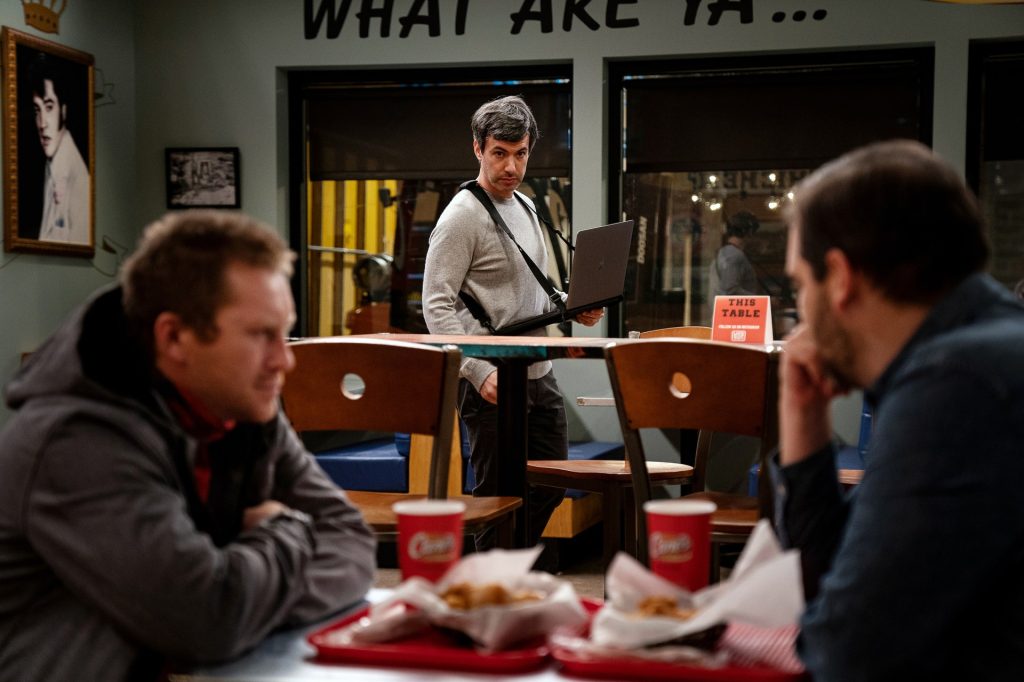
I’ve tried to write this piece so that it’s legible to everyone, regardless of whether or not you have watched “The Rehearsal” (now streaming in-full on HBO Max).
To be clear, though: you absolutely should watch “The Rehearsal.”
I don’t watch a ton of TV, and I go about not watching it in a way that’s probably pretty annoying. Whenever somebody recommends a show to me I do sincerely appreciate it, but I’m always quick to interject with just how little TV I watch, followed by a list of all the famous shows that are surely higher on my queue. There’s “The Sopranos,” obviously, and “The Wire.” “Mad Men?” Haven’t seen it. “Deadwood?” Oh, I’ve heard really good things. I did recently tackle “Breaking Bad” and “Better Call Saul,” so I’ve got that going for me at least. Maybe I’m getting better at this after all. Maybe I will watch that show we talked about. I could make more lists that way. I love a good list. Honestly, who doesn’t?
Here’s a short one. There have been four seasons of television that I’ve found to be completely and utterly arresting in a way that transcends and outlives the moment-to-moment drama that a strong show can conventionally sustain.
David Lynch’s “Twin Peaks: The Return” is an 18-episode monument which lays bare the vacuity of nostalgia, as obstinate and opaque as it is surreal, fulfilling Laura Palmer’s promise from the show’s original run in the early 90’s that she would see Agent Cooper again in 25 years. It’s my single favorite thing in the whole wide world and I’m fairly confident in saying that there will never be anything quite like it ever again.
Season three of “The Leftovers” completes Damon Lindeloff’s fascinating triptych about what humans turn to (and turn into) while making sense of the senseless, doing with religion what “Twin Peaks” does with dreams. Each season is a panel with a distinct texture, and the lofty resonance of its final episodes springs from the show’s simplest but boldest conceits.
Nicholas Winding Refn’s “Too Old to Die Young” is a self-contained single season of television that debuted on Prime in summer 2019 to limited fanfare, and it makes zero effort to ingratiate itself with potential viewers to a pretty hilarious extent, spending its early episodes in a trance, droning in Refn’s signature key through a mysterious, quiet world that seems a degree or two removed from our own. If, however, you let yourself fall into that same trance, you’ll be privy to a beautiful, despairing work that captures a strain of reactionary havoc wrought in the back-half of the last decade but that was simmering long before that.
The fourth?
Hit it, Josh.
In the premiere episode of Nathan Fielder’s “The Rehearsal,” the subject of the first ‘rehearsal’ is a socially anxious man named Kor who is nervous about admitting to his trivia group that he’s been lying to them about having a masters degree. Your first question might be something like, “What even is there to rehearse?”
Well, damn-near everything, as it turns out. Fielder helps Kor plan the confession by constructing a top-to-bottom simulation of the event, rebuilding the trivia bar in a warehouse (down to tiny, lived-in details such as a balloon floating in the corner by the A/C vent) and hiring a crowd of extras to imbue the simulation with life. He hires an actor to play his friend (the one he’s most concerned about confessing to) and has the actor meet their real-life counterpart under false pretenses in order to more accurately capture her nuances and construct an accurate persona.
In a conversation with Fielder, Kor likens the man to Willy Wonka, an analogy which evokes a confused reaction and a series of follow-up questions.
“Wasn’t he a bad guy?”
The back-and-forth proved inconclusive, as Fielder couldn’t quite remember the details of the plot, and Kor, backpedaling after reading his scene-partner’s reaction, tried to assure him that the kids in the factory may not have actually died, and he meant the comparison in the sense that they’re both “dream makers.”
“I’ll read the book again just to look into it,” Fielder says.
The prescience of the exchange regarding the balance of the show’s run is staggering, even though in the moment it’s simple enough to dismiss as the same type of awkward one-off conversation that Fielder has perfected over the years. (Note the placement and timing of the needle drop at the end of the first episode.) And so proceeds “The Rehearsal,” through several arcs of varying lengths that seem to fold-in on each other as participants cross-over and the ethics of it all become increasingly dubious. It contains some of the funniest jokes, bits, and lines that I’ve heard in years, and it also has the capacity to hit like a freight train in a deeply bizarre way. There’s a muted tragedy in the distance between reach and aim, and there are moments of catharsis built on such absurdly convoluted foundations that you almost can’t believe what you’re feeling.
There’s a way to create a show with this premise that might risk reading as a more conventional work founded on an intriguing gambit, but Fielder has no interest in that. Instead, he’s created his version of Frankenstein’s monster, something that knows that it’s alive, and his famously unreliable narration seeps into its obscenely-high-budget non-diegetic presentation. In one moment it’s presenting itself as something out of “Nathan for You,” where Fielder is explaining a set-up for a bit that almost feels like something out of a hidden camera show, but then in the next moment the score lurches and Fielder has re-cast the scene while the cameras turn to film each other. Your question at this point has likely turned to, “Is this real?”
The reductive answer, by most-all accounts, is yes.
The actual answer is one discovered over the course of the show, culminating in a finale where Fielder tries desperately to change it.
The overarching structure of “The Rehearsal” maps extremely close to the near-stream-of-consciousness flow of the individual episodes. It’s incredibly easy to picture Fielder putting himself in the viewer’s headspace upon each set of closing credits; in fact, it’s impossibly easier to picture him doing that than not doing it. If it felt like a given episode is in dialogue with previous episodes in an uncanny, mind-reading, discourse-perusing kind of way, it’s almost certainly because Fielder was anticipating its direction and reacting accordingly, which is an unconventional, almost recursive way to approach artistry. More than that, it’s one uniquely tailored to the medium of episodic television, counting on cycles of viewership, instant reactions, thinkpieces, all taking place in the negative space between each Friday night release. This contributes to the feeling that the show is consuming itself, as each episode is made with the knowledge gained from the last, up to and beyond how it makes a viewer feel.
A popular joke during the season’s run was that, in the end, it would be revealed that we—the audience—were somehow involved in the rehearsal. Ultimately, we just might have been, and the startling cohesion of what we’re seeing as a finished product, as he would say, is no accident.

 On the Image
Leave a comment