I wish I remembered more of my dreams.
For a while I kept a sleep journal for this express purpose. At least, partially so—this was at a point where my passive interest in lucid dreaming turned into a less passive one, and keeping such a journal is a tactic that is supposed to train your mind to recognize its own constructions.
The most interesting thing about this experiment was the degree to which thinking about a certain aspect of a dream seemed to unlock another—sometimes this was a subsequent or causal event to the one which activated the thought, but other times it was something more disparate. The memory of a certain color could propel you to a time where something indistinct gave off that same hue; a texture might do the same, linking flashes of unconsciousness that are more visceral than cerebral in their barely-descript relation. The key to understanding this process is that these cuts from one sequence to another may be jarring to a certain part of your brain (the part that’s internalized the components of conventional narrative function, down to even their patterns and cadences), but that doesn’t mean that it’s “wrong” for them to be unbounded by norms.
Dreams have their own syntax, and part of the reason it’s often so damned difficult to remember them is that the glue tying each frame of a dream to another isn’t of our waking life. The term “dream logic” isn’t coined only to capture the nonsensical content unleashed by sleep, but also the machinations by which they manifest. Sure—in a dream, two plus two can equal five, but the concept of addition can itself take-on a whole new meaning.
I’m certainly not a dream scientist, but I’m pretty sure nobody knows how any of this shit actually works. As far as I’m concerned I absolutely nailed it. And so, too, did Christopher Nolan.
Much of Nolan’s career has been predicated on the notion that he crafts intellectual blockbusters—impeccably assembled, heavy on exposition, emotionally vacuous, and immediately, obviously satisfying for those searching for the next multi-million-dollar puzzle-box. I genuinely promise that I’m not saying this with any sort of scoff or sense of derision—I love Nolan’s movies. I’ll go down swinging in a fist-fight to defend “Inception” (2010), and “Dunkirk” is both one of the best movies of 2017 and one of the most inventive war movies that I’ve ever seen. What I am saying is that the dude has a niche. This niche, largely defined by all these aforementioned descriptors, carries with it a sort of self-serious timbre—these are important films, and all of their components both diegetic (such as their characters and events) and non-diegetic (such as their scores and cinematography) are beholden to this gravity. This held as a general rule from “Following” (1998) all the way through “Dunkirk”—albeit with one bolded exception.
“The Dark Knight Rises” (2012) tends to stand alone in considerations of Nolan’s canon, and that’s because it’s weird as shit. Yes, there are likely external reasons for this—Heath Ledger’s passing could very-well have led to some substantial narrative restructuring, for one—but no conceivable overhaul was going to get around the fact that Nolan was just totally vibing when he made the thing. The main disconnect among its various interpretations concerns its beat-to-beat directorial aim; few would argue that the movie is quite funny, though many would suddenly take issue the moment you ascribe intent to the humor. They’ll say it’s one of Nolan’s weaker outings (sure) and so the humor within must be that kind where you’re laughing at the work instead of with it (needless to say, I disagree).
That the film was a strange note for this particular director to hit isn’t simple revisionism—others have written at length about its foray into camp, and it does seem to have fostered a positive reputation among an online “Film Twitter” culture which appreciates a picture throwing good blind haymaker or twelve, whether or not they land. We can argue whether or not “Interstellar” (2014) also plays nicely in this conversation, but ultimately I bring all this up only to highlight that Nolan has the capacity—dare I say, inclination?—to have some fun.
“Tenet” feeling off is not the result of a tonal misfire—it’s the way that it is on purpose. Still, the question remains: off… how?
The vitality of ‘time’ within Nolan’s oeuvre is flatly evident. From the chopped-up-and-rearranged approach to temporality in “Memento” (2000), to full-tilt time dilation crises presented by “Inception” and “Interstellar,” and even further crystallized in the ticking clock motif at the heart of “Dunkirk,” his relentless drive to test the concept’s rigidity is a fascinating throughline. For a director known to thrive in calculus and precision, it’s not a huge leap to read this tendency as being artistically self-reflective (it’s notable, too, that the conceit at the heart of “Tenet” is the inversion of time itself). Nolan realized that for his relationship with this thematic material to truly evolve in a way that transcends his aforementioned niche, he needed to find a way to engage it in a creative dialogue by way of the very core of his medium: montage.
Anybody who has seen Baz Luhrmann’s “Moulin Rouge!” (2001) knows that the first twenty-or-so minutes hit different as frantic, absinthe-fueled sensory information forces its way through your eyes and ears and clangs around in your brain. (It’s a lot—it’s one of my favorite movies of all time and I’m telling you that the beginning is a lot.) That the movie does eventually simmer down is pretty much immaterial when it comes to how people feel about the movie at its conclusion. The reckless abandon with which Baz ignores what’s “comfortable,” “conventional,” or even “good” in that opening stretch is definitive not simply because it’s a harbinger of things to come, but because it puts the viewer in a headspace that’s either vitally conducive or entirely antithetical to appreciating the film.
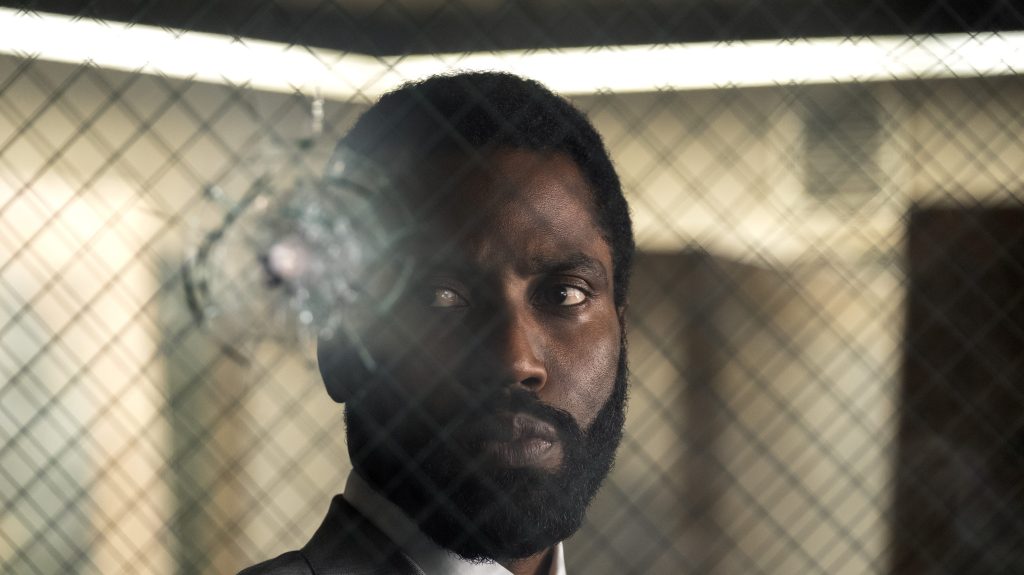
What’s weirdest about “Tenet” can be traced back to a similar (if more subtle) notion of film grammar working on an unconscious level, as—when viewed through a lens of general convention—its pacing can be generously described as “fast-paced and aggressive” or less generously described as “rushed and stilted.” We frequently enter scenes without much at all in the way of establishing where we are or who we’re seeing, and some of the transitional vistas seem equal-parts contrived and fantastical (the shot of John David Washington’s Protagonist doing pull-ups on a freighter in the middle of an oceanic wind farm apropos of nothing is some stellar visual absurdism). Plot devices are bestowed massive, earth-shattering weight while the movie itself seems to be looking ahead to the next set piece, and characters even react to this non-diegetic nonchalance, staring at each other amid inquisitive beats as if questioning what exactly it was they were supposed to be doing.
(Dedicated readers may start to notice parallels between this line of thought and my robust defense of “Jurassic World: Fallen Kingdom” (2018), and they wouldn’t be wrong in doing so.)
So—what’s going on? Why does any of this matter? In “Inception,” Cobb explains,
“Well dreams, they feel real while we’re in them, right? It’s only when we wake up that we realize how things are actually strange. Let me ask you a question, you, you never really remember the beginning of a dream do you? You always wind up right in the middle of what’s going on.”
Before you even think it and get mad at me: no, I’m not suggesting that the events in “Tenet” are a depiction of an in-fiction dreamscape—
—but that doesn’t matter! Because Nolan is wading into new waters here, using the language of dreams to tell his story, and in doing so creating something entirely distinctive from the rest of his canon, back when every second—every frame—asked to be parsed and accounted for. There are certainly still explainer articles out there which try to piece together character timelines and make legible sense from the visceral incoherence, but I cannot imagine missing the point more. The film is designed to funnel viewers from prologue to credits in the same way that a roller coaster is designed to get you to the other side of a platform. Any break in the storytelling momentum risks the thesis, one founded on a willful immersion and faith in a picture’s direction.
“Tenet,” holistically, is the dream you have after mainlining espionage thrillers. It’s what your subconscious cooks up after distilling all that excitement and bombast down to its palpable essence and congealing all of it back into a long-form narrative. The lead character is literally named “The Protagonist.” It’s not a puzzle-box—it’s an exercise in de-abstraction.
My sincere apologies to “Inception,” but Nolan’s latest ‘dream’ movie just happens to be his best.
Grade: A
Tenet is available to stream on HBO Max.
 On the Image
Leave a comment