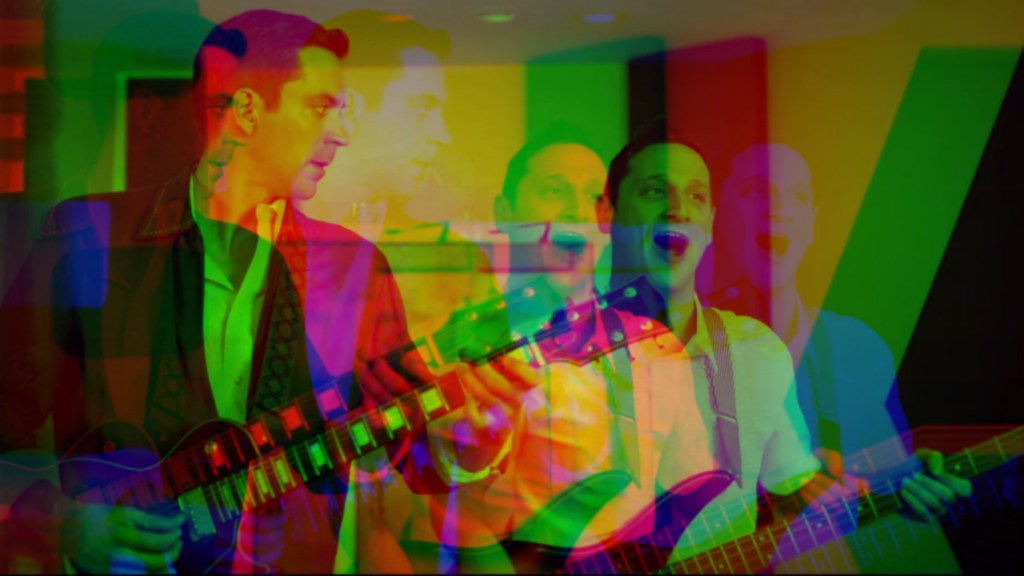
There’s no preface I can include here that could possibly prepare you for the degree of folly that ensues in this piece. Not only do you not have a social obligation to read further, you actually have a personal invitation from me to close this window and go about your day.
If you truly insist, then here’s a shred of context:
I don’t write much fiction, so, on occasion, I like to sit down and think up short genre stories. These take on a straight face, but the tongue is always in-cheek; the oft-flowery language and cliché contrivances are just part of the charm, as far as I’m concerned. On a grimly related note, “I Think You Should Leave with Tim Robinson” is the greatest sketch comedy show of the past few years (I couldn’t even begin to tell you how many times I’ve watched it at this point), and the following song inspired this particular creative outing.
You really must watch this before reading any further—and not just because it’s one of the funniest things I’ve ever seen.
(Better yet, spend a couple of hours bingeing the show on Netflix, comprised of only six very brief episodes.)
Wait—did you actually watch the video or are you just scrolling?
It’s very important that you watch the video.
Assuming you did; here’s… this.
For Marie.
…
“The gospel days are behind me, Father.”
Those were my last words to John as I walked out of his church for the last time, that building perched hillside on the outskirts of town. It was, oh, some Sunday, some number of months back, nondescript but for this memory of my last time stepping foot in that pious little shack. Every time I heard those church bells ringing, I was brought back to that one-sided exchange.
I liked Sunday mornings. They were my alone time, when I could walk the streets and think; most-everyone else I know was packed into the pews, their faces turned up toward the heavens. That day I looked up, too—I often would, though I’m not sure what I was ever hoping to see—but there was nothing above me but an arid tension that sapped the clouds from the sky. Just then, a passing wagon stormed by, kicking up all sorts of dust which hovered ominously outside the saloon doors. Its horses seemed desperate to get away, neighing like their hooves were stuck in a snake hole.
I didn’t understand it quite yet, but, as I turned to spit before heading down the lane, I saw something one generally doesn’t: a body collapsed in the adjacent alleyway.
It was John, flat on his back. Dead.
I felt the indicting eyes of a hundred townspeople closing in just as I heard the cries of the horses fading into the distance.
…
The underworld isn’t as much a “world” as it is a constant fugue state imbued with the curse of lucidity. Down here we shed our skin to make meals, yearning only to satiate carnal desires without the capacity to feel closure. My hunger grows every day, for feeding only heightens my appetite. In this whole hell there’s half as much food as we had above in our humble little patch of desert, and that’s only about a tenth of what we’d need to stave off starvation—if we could starve, that is. My body craved sustenance, my mind stimulation, and—my soul? It burned through my conscience like precious fuel.
How did I end up there? Is it where we all go, or did spurning the divine land me, specifically, among the damned? I can’t say the thought didn’t cross my mind.
Tormented by my sins, I turned against the winds ushering us into forever, and, at that moment, whether through happenstance or by dictate, I saw a doorway appear behind the masses, my name etched into its stone frame.
I instantly understood that this wasn’t damnation, this was a second chance: at life, at love—
—at revenge.
…
Robert Palins doled out the justice for our precinct. His idea of criminal law rendered executions simply an afterthought of his rulings, a redundancy that the man’s no-doubt only kept around because they won’t let him pull the lever himself. For all these years he’s killed from his chair; the rest is just a formality.
My trial commenced and proceeded with that same, mocking inevitability. At its close he reached out for his piece, one that had put more men in the ground than any six-shooter west of the Mississippi. He held it in the air for a moment—an eternity—cocked back and primed to deliver a lethal blow, and I knew better than anyone in the courtroom that the space between its head and the block below measured my time left as a free man.
No use suspending any longer what’s coming; on this I reckon we both agreed. I looked him dead in the eyes, and, meeting my gaze, he brought that hammer down.
…
What happened next I can only relay as I remember it.
I stepped into a chamber, meeting a monstrous figure I somehow knew was called the Keeper. Muttering something about ancient arcane restrictions, he prepared me for my return.
The beast extended its arm, expectantly, and I inferred the need to reach for one of my ribs, breaking it off and handing it over like a morbid currency. I paused, noticing that a worm had burrowed into the marrow and was half-wriggling helplessly before us. This peculiarity seemed to sweeten the deal, as the Keeper plucked it from the rib and grinned as skeletons cannot.
The transaction complete, I emerged from the ground, rising from my future and turning back, one final time, towards my past.
…
When the floor gave out beneath me, I dropped like Palin’s gavel.
Her scream is the last thing I heard. My sweet Marie: could I have done more to soften her cries?
The thought killed me again and again until I’d died a hundred deaths, although I’d only left the one body—the same one the town had in the ground by nightfall. People here don’t do much with haste, but they didn’t waste any time digging me a ditch.
In this town, murderers don’t get ceremonies.
…
His jet-black mare, camouflaged against the night sky, was still hitched to the tree outside the courthouse doors. It was common knowledge that Palin and other enforcement-types loved to debauch even the thin veneer of integrity the institution maintained under the sun. They’d deal cards, throw dice, and down liquor, engaging in mutual vice well-into the dead of night. After making my way over to a corner room basking obliviously in the glow of candlelight, I heard the bastard’s voice.
He was laughing.
With an instinctual resolve that chilled whatever mercy remained in my spirit, I interrupted their conviviality and lurched into the room. The two men opposite the good judge snapped out of their drunken stupor just long enough to shout something unintelligible and stumble out the door along the far wall. Palins, visibly confused, briefly threw up his hands before starting to rake-in their chips.
Wasting no time, I seized his skull from behind and threw it against the table. He lost consciousness in an instant, dropping his hand face-up—a straight flush with spades. Part of me wanted to wait for him to stir just so he wouldn’t die a winner, but that part of me—the part that was human—was still in the ground.
I reached down and pulled his hair up, gentle-enough so as not to loose a single thread, and the man’s head floated beneath my hand as would a marionette. I rocked it slowly from side to side, feeling more agency in those few seconds than I ever did in life.
Like a bow on a string, playing for an audience of none, I slid a knife across his throat, turning the spades red beneath him.
Most men will never understand true satisfaction, but—even as I noticed that this, my last act of sentience, had contorted Palin’s neck, pressuring and severing the tenuous connection between the hair caught in my grasp and his lifeless scalp—even as I now recalled the Keeper’s cautionary remarks, suggesting existential consequences for defiling the integrity of living hair—yes, hair, of all things—I knew that I was satisfied.
Sleep well, my love—now and forever.
My bones, damned to dust, fall resolutely to the floor. I am no more, and will never be again.

 On the Image
Leave a comment