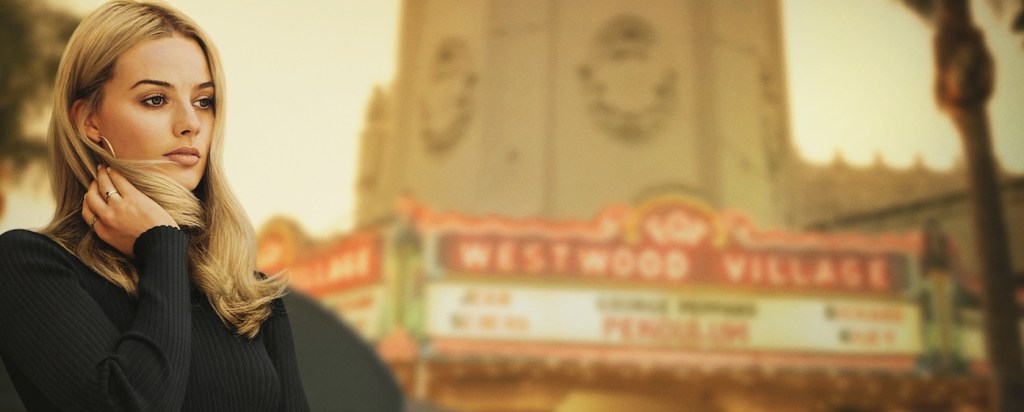
This piece features sensitive plot details of “Once Upon a Time in Hollywood” (2019) and “Inglourious Basterds” (2009).
We hear her before we see her. From a call box positioned near the driveway’s edge at her home on Cielo Drive, Sharon Tate’s voice (portrayed here by Margot Robbie) rings out with a reaching, metallic timbre, at once identifiably nostalgic and boundlessly ethereal; it’s a sound that is definitively of a time without being consigned to it. Her words are a “Llorando” for the viewing audience, stirring the soul and highlighting that the disconnect between history as we understand it and that which belongs to the film has erupted into a nigh-unbridgeable chasm. Just as David Lynch’s “Mulholland Drive” (2001) uses the immediacy of Rebekah del Rio’s performance to make both viewer and character alike aware of their heretofore idealistic state of immersion, “Once Upon a Time in Hollywood” director Quentin Tarantino takes this moment to highlight the fictional fissure through a moment as deeply human as it is tragically ahistorical.
We as viewers find ourselves on the side of reality, gazing cautiously—surreally—at and beyond the screen, into the world it now depicts.
It begins in the dark.
From a room above and behind the seats, the projector plays the first note—just a gentle, persistent, whirring tone, but one immediately accompanied by the buzzing of a bulb. Then the first reel of film starts to spin, flittering on its tracks, beginning its process of sculpting light rapidly and repeatedly along gradients of color and shape as dictated by each individual frame on the print.
Film as a medium has a rich history of using noise as a harbinger of the image; we hear it before we see it—we used to, in any case.
Our present era is dominated by digital projection; with the press of a button, movies are conjured swiftly and silently, displayed with a striking visual fidelity and modern ease. Given this ubiquity, it might seem a fair bit anachronistic to begin the discussion of a major contemporary release with a brief, pandering paean for an old screening method (one for which this writer certainly can’t claim any first-hand nostalgia).
It might, but Tarantino—ever the cinema classicist—has made concerted efforts to preserve the practice of analogue projection, exhibiting his latest pictures on 35mm and 70mm film print. The more cynically-inclined might see this as a gambit relying on a shared pretention between promoter and consumer, for what difference could the method of display possibly make? In response, of course, there are many who swear by the tangibility of film print and the richness and imperfection of the resulting imagery.
Tangential to this feud, there is something to be said for the idea of a collective buy-in—of mutually ascribed meaning. Nowadays, seeing a film projected in the traditional style (and often paying a bit of a mark-up to do so) constitutes an extra step towards justifying our willful immersion, and knowing that you’re surrounded by people who choose to do the same certainly isn’t nothing.
We all just want to be transported, and that’s exactly what Tarantino is counting on.
An uneasily placid night accepts our roaming protagonists back to California. Rick Dalton (Leonardo DiCaprio) and Cliff Booth (Brad Pitt) are returning from Italy, having just partnered together to film, among other things, a Spaghetti Western helmed by the genre’s (second-) best director. Their flight, as noted by an expositive caption scrawled ominously against the fourth wall, is landing on August 8th, 1969.
The plane touches down like a needle on a record; cue The Rolling Stones’ “Out of Time,” a song which exudes a snappy verve that hooks our leads into the night. In a lightly comical slow motion walk which still manages to embody an effortless ‘cool’ echoing Tarantino’s famous introduction of “Kill Bill’s” O-Ren Ishii (Lucy Liu), the crew leaves the airport and heads into the city.
This energy climaxes in an act of supreme coordination, divine dictation, or coincidence—the type of event that restores faith and erodes rationality. Summoning a heretofore-contained surge of collective electric power, a vast ignition floods the Los Angeles sky. Restaurants, service centers, and theaters all join together in a visual chorus; these light displays come to dominate the picture, each in its turn sprawling across the frame, crackling with a communicative power that supersedes its common, outwardly promotional purpose. Far more than dotting the horizon or sparkling across an expansive vista, these bulbs confront—fighting against the darkness of the night just as they seem to push against the surface of the screen from within, straining to defy the constraints of the medium.
This sequence does something extraordinary, seemingly reversing everything we know about the relationship between the projector and the screen. We begin to get the sense that, even if the projector ceased to function, these signs would somehow persist, that their shine is autonomous. Conjured by some combination of chemistry and magic, as its light washes over our faces we can’t help but feel that the world onscreen is as ‘real’ as anything else—and we’re right there.
More than perhaps any film in recent memory, “Once Upon a Time in Hollywood” actively leverages the viewer’s knowledge of the past.
Imagine a film’s relationship with history as two lines running through space concurrently, the distance between them simply being the movie’s separation from reality. No movie can truly eliminate the pesky, immeasurable delta between subject and presentation (no doubt to the dismay of many a neorealist); however, within this framework, it becomes clear enough that predominantly nonfictional works leave considerably less room than, say, works of historical fiction, and so on along the spectrum of fabrication.
We need not even turn from Tarantino to find one of the most prominent contemporary illustrations of the dynamics at play within this metaphor, as his 2009 feature, “Inglourious Basterds,” has become a sort of cultural shorthand for this very concept. Taking place during World War II, the film follows a group of Jewish American soldiers, their plot culminating in the assassination of Adolf Hitler. For much of the narrative, events unfold in an historically-fictive way to which most viewers are likely already accustomed; after all, the obscurities of history are often reduced to a bit of a blank slate, but—one assumes—not one without an overarching, familiar outline. We might, for instance, feel some level of assurance that the war will end in much the same way that we remember learning about in grade school, and it’s just that assurance that Tarantino subverts and converts into catharsis.
“Once Upon a Time in Hollywood” follows a similar blueprint; the gap between the movie’s events and recorded history remains relatively narrow for hours and, despite the prominence of its fictional protagonists, fairly discrete. Tarantino, often a genre-as-mode maximalist, here opts to obfuscate, interweaving the stories of Rick Dalton and Cliff Booth with a world that feels thoroughly authentic, one constructed with painstakingly restored settings, the faithful portrayal of prominent persons, and a diegetic soundtrack flush with period-appropriate hits. Of course, for viewers familiar with much of what’s represented onscreen, a dread about what’s coming pervades the proceedings. After an entire film’s-worth of crescendoing stakes and tangling plotlines, we swerve again into an alternate timeline where history’s monsters are incinerated.
The film’s core conceit is inherently a tragic one: saving Sharon Tate, Abigail Folger, Wojciech Frykowski, and Jay Sebring from the events of a night forever-etched into recollection while also illustrating an impossible justice. It’s a gambit condemned to fail from its onset, underwritten by the shared understanding of history as it exists, but one that nonetheless demonstrates the power of film to instill a sense of memory and understanding that takes root in the minds of viewers and is then carried through their lives. With this picture Tarantino explores the tautological limitations of art while also demonstrating one reason why it’s so unspeakably important, seizing an opportunity to foreground Sharon Tate in the public consciousness not as she died, but as she lived.
Film can’t bring people back, but it might, if only briefly, let us exist once more in their light.
We’re back where the driveway meets the road on that night. We know the history, but we also know what we just saw. We know that what happened, didn’t.
Upon hearing news of the incident, the one at Rick’s house, Tate gently checks to make sure everyone is alright. She then shifts her focus to Rick, asking him the same—he’s okay, he says—before inviting him up to meet her friends.
The camera takes a step back as the gate begins to open, the creaking of its hinges sounds in unison with the opening notes of Maurice Jarre’s “Miss Lily Langtry,” a song imbued with a tense buoyancy. Its melody rises unevenly but inevitably, tip-toeing along an elusive key on its way up, and so too do we drift, over the men and through nearby trees, coming to rest just above the Cielo Drive home. We see Tate, followed by her company, emerge from the house and greet Rick. The sweet mundanity of the moment only makes what comes next that much more difficult to bear.
We read the end title card, “Once Upon a Time… in Hollywood,” and come to fully understand the significance of those first four words.
The imagery lingers, its purpose fulfilled. We’re happy to linger, too, as the final shot persists; as “Miss Lily Langtry” continues to play; as the cast listing comes and goes; as this final image eventually fades into the closing credits; and then as the credits briefly give way for one more interlude featuring Rick Dalton. He’s filming a commercial for Red Apple cigarettes, a fabricated brand that has become a calling card for Tarantino—references to its products are littered across the director’s oeuvre.
Rick knocks over a life-size cardboard cutout of himself before storming off the screen, ranting about his double chin.
The movie may be over, but he’s still here.
Suddenly, we hear a final click from the projector, and our room, once again, is dark.
 On the Image
Leave a comment