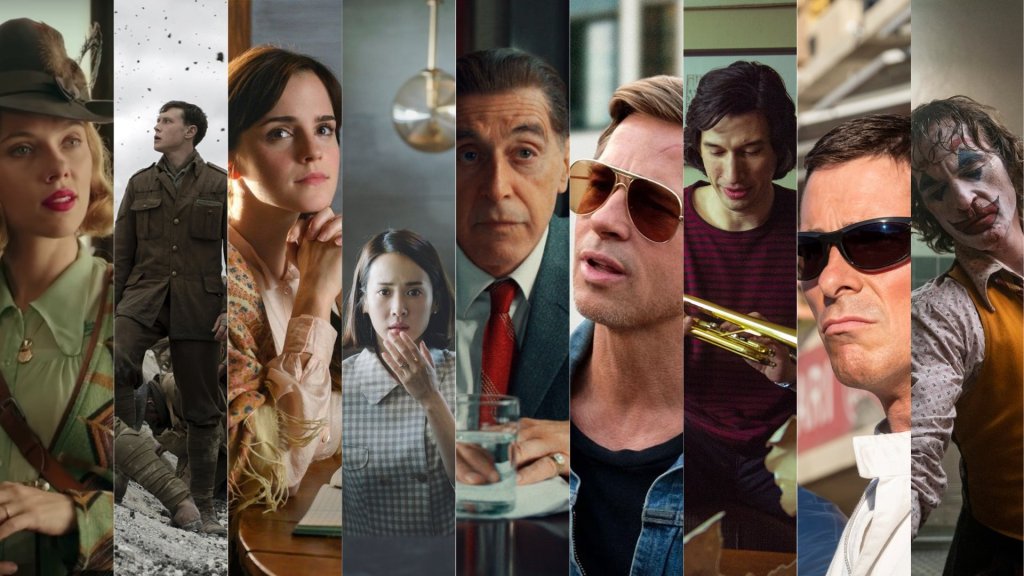
It’s officially Oscar Sunday; can you beat it?
And it actually is Oscar Sunday, like, as I’m sitting down to write this. I’d meant to get this out yesterday, but I got distracted by the Film Independent Spirit Awards—or, as they’ll forever be known under my roof, the Good Oscars. (Awards shows don’t have to suck.)
After giving its top prize to “Green Book” just last year, the Academy thought it’d be a swell idea to try this whole thing again. So, like a good pretend critic, here I am with my yearly walk-through of the categories I find especially engaging. This edition is much less comprehensive in scope than years past—I’ve chosen to highlight only four rather fundamental awards (three if you fairly discount my handling of the Best Picture section)—but I’m hoping to provide more substance than before for the fields I discuss. As always, following each section I’ll say which nominee within the relevant group I’d like to see win on Sunday night.
So yeah, this is less of an actual walk-through and more of a gauge on the awards that’ll determine how upset I am tomorrow. Do I think any of my preferred picks will actually win tonight?
No, I don’t! And this hurts my feelings.
But let’s start, once again, with…
BEST DIRECTING
- THE IRISHMAN Martin Scorsese
- JOKER Todd Phillips
- 1917 Sam Mendes
- ONCE UPON A TIME… IN HOLLYWOOD Quentin Tarantino
- PARASITE Bong Joon Ho
For many moviegoers, discussing a film’s direction can get a bit abstract. If it’s not the script, it’s not the editing, it’s not the photography, it’s not the acting, it’s not the soundtrack, and it’s not the combination of all of those things (that being—presumably—the picture itself), then what even is this all about?
One of my good friends in high school made short films, and he would see these through from start to finish on most-all fronts (of course, there would be actors). He’d write-up screenplays, frame shots on his DSLR camera, make music on a MIDI keyboard, and edit the raw footage into a final product, and seeing this process play-out served as a potent distillation of everything what it means to make a movie. You can hire specialists to cover each and every one of those functions, but—in essence—that’s what directing is about: overseeing the process, making sure that you’re getting exactly what you need from each of the film’s many facets, and corralling everything into a singular artistic vision.
To borrow from Sorkin: the director plays the orchestra.
Of course, it is objectively wild that Todd Phillips got a nomination for “Joker,” a film in which the only real long-term intrigue is found in the civil war between its contradictory constitutive elements, while Greta Gerwig (“Little Women”), Lulu Wang (“The Farewell”), Claire Denis (“High Life”), and Joanna Hogg (“The Souvenir”) all directed some of the best movies of the year. I don’t want to make this solely about Todd Phillips—”Joker” is just the low-hanging fruit—I just want to provide yet another illustration that the gender disparity in this field isn’t because “the men just happened to make better films this year.” Nominate Gerwig, Wang, Denis, and Hogg, and your field of directors is all the better for it.
For what it’s worth, Bong Joon Ho, Quentin Tarantino, and Martin Scorsese are also very good picks. (I’m not sold on the efficacy of “1917’s” core conceit, but what Mendes accomplishes with the film is doubtlessly impressive.) Give this award to Martin Scorsese for deftly fusing his religious profundity and sensitivity with a reflective treatise on the gangster film genre.
My Vote: THE IRISHMAN Martin Scorsese
FILM EDITING
- FORD V FERRARI Michael McCusker, Andrew Buckland
- THE IRISHMAN Thelma Schoonmaker
- JOJO RABBIT Tom Eagles
- JOKER Jeff Groth
- PARASITE Jinmo Yang
Hey, the Academy—where the shit is the nomination for Ronald Bronstein and Benny Safdie’s work on “Uncut Gems?”
Film editing, at its core, is syntax; you can have the world’s most expansive vocabulary, but if you can’t string your fancy words together into a sentence then what you’ve actually got is nothing.
I’d like to briefly discuss a brilliant example of effective editing that’s largely gone unheralded among the awards-season chatter. I’m talking, of course, about the parallel construction in Greta Gerwig’s “Little Women” (and specifically one scene—”spoilers” ahead for “Little Women,” I guess). Midway through the film, Gerwig and editor Nick Huoy juxtapose two instances of Jo March (Saoirse Ronan) waking up in her family home and heading downstairs. In the first, she wakes up, sees that her ailing sister is no longer lying in the bed next to her, rushes downstairs, and finds her sitting at the kitchen table. The urgency is relayed in not only the pace of the cuts but what images are cut to; her hand gripping the stair railing has stayed with me more than almost anything from 2019, and that’s mostly due to how it was shown. In the second instance, Jo once again finds that her sister is gone, though this time her movement relays a dreadful resignation. So, too, do the film’s cuts. Her short journey to the kitchen is stretched by a grim inevitability; she walks down the stairs without needing to hold tightly to the railing, and, when she arrives at the last step, she ultimately finds her sister’s seat empty. It’s a heartrending sequence, made more so by an emotionally sensitive edit.
I’m going to be honest; every year it feels like this category is largely cobbled together from the best picture nominees that are there only because all the voters watched them (“Jojo Rabbit” and “Joker”) or that display some level of competency inherent to crafting pictures in their respective genres (“Ford v Ferrari”). Don’t get me wrong, there are often best picture candidates which would belong in a more inspired film editing field, and indeed we do get nominations for “Parasite” and “The Irishman.” The former is a labyrinth of perspectives, and Jinmo Yang’s ability to cut through the film’s house while juggling the ensemble’s points-of-view and dialing the tension completely taut is indisputably phenomenal.
This year, though—as so many should—belongs to Thelma Schoonmaker, a legend in American film history and Martin Scorsese’s longtime collaborator. “The Irishman” is an absolute goliath, clocking in at three hours and thirty minutes. It moves at a brisk yet intimate pace through Frank Sheeran’s life, artfully cataloging moral evidence as though for final judgment, and then anchors itself over the void which comes to consume his existence. To assemble such a fresh and impactful work in a realm which at first seems to be largely trodden ground is an unrivaled, unimpeachable achievement.
My Vote: THE IRISHMAN Thelma Schoonmaker
CINEMATOGRAPHY
- THE IRISHMAN Rodrigo Prieto
- JOKER Lawrence Sher
- THE LIGHTHOUSE Jarin Blaschke
- 1917 Roger Deakins
- ONCE UPON A TIME… IN HOLLYWOOD Robert Richardson
The way that cinematography has been absorbed into mainstream discourse is both heartening and slightly off-the-mark. If you’ve spent much time at all on Twitter (if you haven’t: congratulations) then you’ve likely seen threads devoted to a film’s cinematography that include several still frames and no real elaboration beyond the image, and these are typically great for fostering discussion and normalizing more technical terms and concepts that aren’t consistently visited in most watercooler movie talk. They do entail one note of caution, however, and that’s not to conflate the more holistic notion of cinematography with the aesthetic success of a film’s photography.
Cinematography is not simply shot composition as pleasing portraiture, it’s how the choices behind the composition serve the picture beyond the matter of literal depiction. Often, as good cinematographers are wont to ensure, the concepts do go hand-in-hand; a shot which stands as a striking image is often carefully constructed to convey information which resonates with the film’s nature and narrative. Sometimes, even, strong cinematography may not result in spoils of painterly frames—think of the grungy, manic camerawork that contributes to the Safdies’ aesthetic in films like “Good Time” and “Uncut Gems.” There’s certainly nothing wrong with a shot looking great for its own sake, but it’s good to note that there’s ultimately more to it.
Looking at this year’s field, I’m first struck by the absence of Adam Newport-Berra’s work on “The Last Black Man in San Francisco.” After processing the snub, though, I see a solid field of nominees with two real standouts: Jarin Blaschke (“The Lighthouse”) and Robert Richardson (“Once Upon a Time… in Hollywood”). Richardson (in concert with production design and a ridiculously spot-on soundtrack) was able to import an entire era into screening rooms around the world, and the way he captured the transition to nighttime in the lead up to the movie’s climax is one of the moments of the decade in film.
Blaschke’s work on “The Lighthouse,” though, is transformational. He lends texture to light itself and turns darkness into matter, imbuing it with properties that allow it to seep, drip, and otherwise move uneasily across the already-claustrophobic screen (the film is shot in a 1.19:1 aspect ratio; considerably more square than viewers are accustomed to). This works to create and impart sensations which seem both alien and immediate, almost bridging the gap between the film’s absurdist horror and our world. It’s an unequivocal masterclass.
My Vote: THE LIGHTHOUSE Jarin Blaschke
BEST PICTURE
- FORD V FERRARI
- THE IRISHMAN
- JOJO RABBIT
- JOKER
- LITTLE WOMEN
- MARRIAGE STORY
- 1917
- ONCE UPON A TIME… IN HOLLYWOOD
- PARASITE
Every year—every year—I run out of steam in these walkthroughs and phone-in the final segment(s) with some gimmick instead of actually talking at-length about my thoughts.
This year is no exception. (Plus, the show starts in like five hours.)
Below I’m going to list the Best Picture nominees from worst to first alongside my potential reaction to each being crowned. Thanks for reading; sorry that this is how it had to end.
9. JOKER – Absolutely not.
8. JOJO RABBIT – Happy for Taika Waititi, but *wow* this one really missed the mark for me.
7. FORD V FERRARI – I mean, I guess that feels about right. It’s not an offensive pick but man. It’s just a two-hour version of the trailer.
6. 1917 – This one is probably going to happen, and to that I say: “fine.”
5. MARRIAGE STORY – Excellent movie and exciting pick; its themes are beautiful and much more nuanced than a great deal of what we see every year.
4. LITTLE WOMEN – This would be so wonderful. All of the film’s components coalesce into a near-perfect movie; Greta Gerwig is an absolute force.
3. PARASITE – Unbelievably exciting winner that could help shatter the stifling relationship between the Best International Film and Best Picture categories. This one could actually happen!
2. ONCE UPON A TIME.. IN HOLLYWOOD – My favorite movie of the year which helped me set a new personal record of “times seeing a single movie in theaters.” (… Five.)
1. THE IRISHMAN – The correct pick; one of the very best movies in Martin Scorsese’s unparalleled career.

 On the Image
Leave a comment