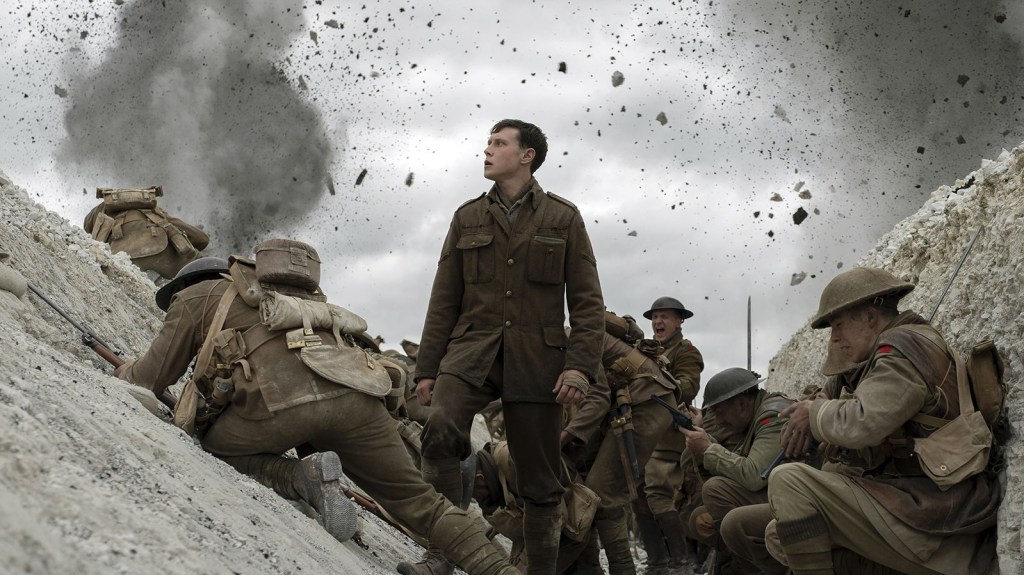
A young man stands atop and alongside a trench in the midst of World War I. He’s facing us, just as we face him. He takes a step, and then another; we pull back, matching his pace. He leans into a sprint, running with a motivation backed by desperate vitality, for his is a monumental task whose dereliction entails impossible consequences.
Deliver a set of orders to a commanding officer positioned many miles away in a matter of hours; failure to do so will result in the deaths of thousands.
Miles seem to have become yards, but so too have the hours dwindled, first to minutes, then seconds, then—
—a whistle blows, and the impossible manifests.
In an unbreakable wave, soldiers begin to pour from the trench. Each soldier, too, is young. They run with an inevitability backed by instructions force-fed to them by a war machine, a man-made monstrosity whose malice is matched only by its cosmic meaninglessness. One by one these men are delivered into the afterlife, and we watch as our protagonist sprints by each of those he fails to save at the exact moment he fails to save them.
So goes the best scene of Sam Mendes’s “1917,” an unimpeachable height across not only this film, but the past year in cinema. Well-toward the end of its runtime, it is the first of the film’s many set pieces to feel truly resonant in a way that supersedes its technical prowess, and in its power the film finds its voice, salvaging a spiritual coherence from its at-times clinical machinations. By speaking to the sheer absurdity of the responsibility foisted upon the men at its center and to the existential hopelessness which saturates the soldier’s view of a battlefield, “1917” finally offers something that might push back against the knee-jerk reactions stemming primarily from its mastery of spectacle.
It should be noted that a film at all needing to push back against the bulk of its runtime is not normally considered to be ideal, though the case of “1917” isn’t necessarily one of intratextual thematic conflict. Far from acting as any sort of overt glorification of war, the film seems determined to convey the visceral nature of its horrors—to an extent—from its first frame to its last. Furthermore, I don’t think it’s too generous a read to suggest that its entire thesis is centered on attempting to communicate these horrors by way of theatrical enthrallment.
Unfortunately, the realization of “1917” falls short of this goalpost, and the primary reason it does so is inextricably bound to centering its language around spectacle—both in front of the camera and surrounding its very workings.
The purported goal of single-shot filmmaking is to capture and maintain a heightened immersion from the perspective of the viewer. The thinking goes that without conspicuous edits, the viewers’ mind will be lulled into a state where it perceives the onscreen action as something that skews more naturalistic and less artificial. Our day-to-day lives don’t have cuts, so—conceivably—removing them from your picture is a way to draw invisible, unconscious parallels between a work and our reality. To be sure, many famous “one-takes” in movie history are known for their immersive allure—think of the restaurant entrance in “Goodfellas” (1990) and the depiction of Dunkirk in “Atonement” (2007). These are often embedded within films which contain a more conventional editorial philosophy (that is, the movies elsewhere utilize noticeable cuts), allowing the sequences to feel different as they play out, even if only subtly so. In fact, it’s often not until further reflection that viewers even realize that something was actually achieved in one take. This is the ideal deployment of any cinematic technique, to properly serve and highlight the truth of its scene and, in-turn, the scene’s function within the film as a whole.
What you risk when building an entire picture around technique is, ultimately, the inversion of this relationship, drawing attention to the craftsmanship of the film (mightily impressive though it may be) and away from its diegetic continuity and overarching message. Filmmaking actually has a language that we, as a collective viewing audience, have come to understand fluently, and although we don’t generally think of movie-watching in this way, we tend to notice when familiar conventions are broken (imagine a film cutting to a new shot every second for two hours). Edits work to form syntax and provide structure, helping to frame action along temporality; each cut is calculated to provide new information and propel viewers through a scene. Replacing edits with manual camera movement for the entirety of a feature film can prove cumbersome, yielding meandering sequences that serve little purpose other than setting up the next significant frame. While, theoretically, the single-shot conceit melds quite well with the nature of “1917’s” race-against-the-clock narrative, it still stumbles into these aforementioned pitfalls inherent to a near-wholesale refusal of the cut.
In the moments that “1917” realizes its full potential, it is electrifying. Its visceral thrills bleed into metaphor, calling the heart to action, priming it for the vice-like constriction tied to the brutality of the wartime theater. However, where the true masterpieces of the war picture genre separate themselves, think of such films as “Apocalypse Now” and “The Thin Red Line,” is in their subversion of spectacle (if they don’t abandon it completely). They harness their artifice to grapple with the corrupting madness of a system which dehumanizes and disposes; if poetry is indeed to be found, then it’s found entirely outside and in spite of this system. The spectre of war is an unspeakably hostile entity, and a feature-length window into its workings should unsettle and disorient the soul, imparting the tiniest shred of its amoral madness. Walking out of “1917,” I thought about the talent that went into staging and executing its setpieces, the touching emotional resonance of its storybook construction, and how many damn awards it’s going to win this season.
It’s an amazing ride, but I’m left wondering if it shouldn’t be.
Grade: B
“1917” is in theaters now.
 On the Image
Leave a comment