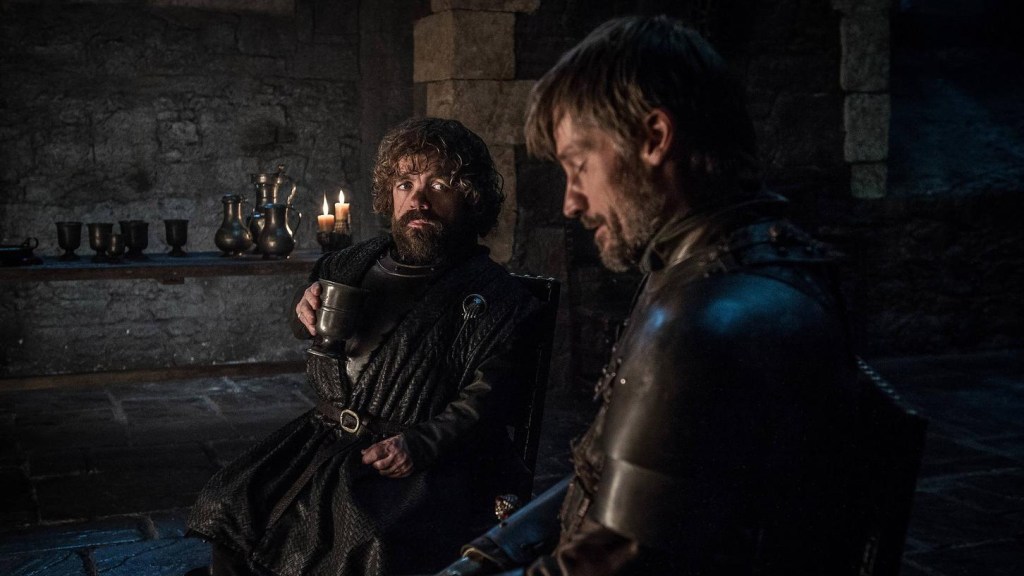
The second episode of “Game of Thrones’” eighth season, “A Knight of the Seven Kingdoms,” is an extraordinary hour of television, a high-water mark not just in an admittedly lackluster stretch of the show, but in its entire, dauntingly formidable canon. It represents a deliberately constructed return to form among episodes whose pacing and focus had grown detrimentally erratic in its waning years. It also stands as a revitalizingly vulnerable moment in which the show lets down its oft-steely guard in order to level with the viewer and bare an honest affinity for its characters, each of whom is preparing for their demise at the hands of an inscrutable, unkillable army. In these, the final hours of their lives darkened by looming horror, “Game of Thrones” strikes an introspective chord that resonates differently with each viewer.
But what is it really about?
The emotional heart of the episode beats tenderly inside of a song, “Jenny of Oldstones,” bared only as Podrick sings to a small group seated around a fire, his voice accompanied by the faint whispering of the flames.
High in the halls of the kings who are gone
Jenny would dance with her ghosts
The ones she had lost and the ones she had found
And the ones who had loved her the most
“A Knight of the Seven Kingdoms” Is about anxiety.
Anxiety has a quietly pernicious ability to create personalized embodiments of dread, fostering them as they speak to you in ways that weaponize and amplify your irrational concerns. It strings together convoluted conspiracies delivered with a tone that betrays your inherent trust in your own mind, seeming to understand you better than you know yourself. It tells you that the moment you’re living in is too good to last; even if things aren’t particularly great, anxiety makes sure that you know that they’re nonetheless better than you deserve. It tells you that everything you’ve done has led not to this height itself, but to its end. It says all of this, and then it reminds you repeatedly. It is tireless in its efforts to blame, undermine, and consume, ensuring that its voice is at its most powerful when you are at your least. It results in an inability to be outwardly present amid thoughts that get caught in self-defeating loops, trying in vain to solve a solutionless problem.
By no means is this experience universal among those who know anxiety well; for some people it can manifest in terrible, physical fits of panic, and for others it can layer urgency onto the mundane and evoke heightened emotional responses in interpersonal exchanges. In many respects I consider myself lucky that it generally lingers for me strictly in a mental capacity. Even still, my anxiety is something that arrests from the inside as it conjures images as patently ridiculous as they are viscerally monstrous, as practically implausible as they feel witheringly inevitable.
“Something is coming,” it likes to say.
The ones who’d been gone for so very long
She couldn’t remember their names
They spun her around on the damp old stones
Spun away all her sorrow and pain
“A Knight of the Seven Kingdoms” is about Fate.
As a whole, “Game of Thrones” is a dynamic, fantastical record of humanity both influencing and reacting to structural forces whose full extents lie beyond the scope of its world’s inhabitants. Occasionally, characters crop up and tantalize by way of their seeming mastery of these forces, but these instances are shown time and time again to be largely illusory, flashes in the pan of a world ruled by inevitabilities much larger than any person. Everyone’s fate, regardless of status, occupation, or identity, is governed as such.
“A Knight of the Seven Kingdoms” is as concrete a depiction of this rule as the series contains, presenting the idea of a constant existential threat made manifest outside of the gates of Winterfell, inside of which the entire surviving ensemble is feeling the same weight. Each person barricaded within sees their story as ending in the coming hours, their whole lives lived just to be halted here and now. The stakes are pressurized—condensed and elevated into something that strays from the traditionally grounded texture of the series and enters a dream state, poetic and a bit surreal.
Watching everyone onscreen wait together in the face of collective imminence, I sense an immutable parallel as unsettling as it is cathartic begin to grow between these proceedings and a feeling that has crept into my life time and time again. I see the timeline of the show collapse in on itself; the notion of temporality seems to compress insofar that everything in the past and present starts to feel condemned by what lies ahead.
I wonder, “Why does this feel familiar?”
And she never wanted to leave, never wanted to leave
Never wanted to leave, never wanted to leave
“A Knight of the Seven Kingdoms” is about Time.
Your perception of time is a vital thread which reaches through everything you know, bonding your most distant memories with your most reaching aspirations. It’s only when it starts to shrink that you realize that its not actually tethering these ideas to you, but merely extending a lane by which you can visit them. It’s only when it’s completely withdrawn that you feel the vacuum left in their absence; it’s only in this void that you fully realize their significance. To see this—admittedly, through my own, uniquely warped prism—represented in a show whose epic, sprawling scope lies at the core of its identity is astonishing enough, as everything from its historic earliest seasons to its wildest climactic potential seems at once to fall eerily out of reach.
Then, as though recognizing something stirring and rising from a pool of abstraction, we hear “Jenny of Oldstones.”
At first, we hear only Podrick’s voice, singing a cappella to a room of similarly situated souls. Then, as though slowly sensing the significance of the moment just as we do, the show itself begins to underscore his words, providing an instrumental accompaniment and merging the diegetic with the non. By the time he reaches the chorus of his song, I again feel a twinge of recognition, as lyrics that outwardly yearn for one thing seem to echo with a deeper, almost paradoxical contradiction.
They danced through the day and into the night
Through the snow that swept through the hall
From winter to summer then winter again
‘Til the walls did crumble and fall
“A Knight of the Seven Kingdoms” is about unresolvable tension.
Present are two desires, the first of which is denoted directly: this is the longing that desperately wraps itself around the immediate, one that feels the dripping away of each passing second as though it is being slowly bled into nothing. “She never wanted to leave,” Podrick sings, and we instantly understand the sentiment as it relates to the moment. What waits for these people is all-but-assured destruction, so the natural inclination is to cling to the present as though in protest of the passage of time.
However, therein lies the contradiction: to indefinitely cling to a present made miserable by this vice-like grip is to ensure that misery sustains indefinitely.
It’s extremely difficult to break free from this loop; it’s certainly not a simple matter choice. Even after acknowledging what is happening and standing as far outside your head as possible, the conflict remains. My experiences in such periods of anxiety-fueled stasis are dominated by a wish to stay forever inside of the moment just before everything is doomed to fall apart, yet also by an almost-frantic energy wherein I so desperately want to be anywhere else, distanced from the invasive thoughts and fears that constitute “now.” These forces seem to stand in staunch opposition, and from their tri-tonal dissonance emerges a malevolent, cold, and isolating pall.
And she never wanted to leave, never wanted to leave
Never wanted to leave, never wanted to leave
“A Knight of the Seven Kingdoms” is about Art.
The canon of a TV series is about as literal a conception of such a timeline that you’ll find in art, one that let’s you scroll through and select from its events on a whim. I don’t mean to be reductive in choosing this illustration, rather, I think its simplicity allows it to function on a meta-textual level. I remember one of my first reactions to this melancholy, recollective hour being an eagerness to revisit old episodes of the show, and in this I’m sure I’m not alone. The funny thing is: we can do that; we’re actually meant to do that. In its original run, viewers had a week between episodes, and (anecdotally) many used this time to reminisce, just as the characters had done.
It turns out that these dire stakes do not, in fact, render the past meaningless; instead they imbue it with incalculable significance, both within and outside of the work. To borrow a phrase which often crops up in similarly morbid tales, it’s as though the lives of every character began to flash before their eyes, and within these flashes lives “Game of Thrones.”
“All men must die,” the show purports, and for so long it marches on with this singular vision, looking ever-forward and never back. In “A Knight of the Seven Kingdoms,” Samwell Tarly artfully and refreshingly elucidates the concept at the heart of this axiom:
“That’s what death is, isn’t it? Forgetting. Being forgotten. If we forget where we’ve been and what we’ve done, we’re not men anymore.”
Sam rather elegantly leaves the door open for a poetic corollary, one which suggests that life itself must then be painted with strokes of memory and experience, and it’s remarkably appropriate that this emphasis comes in the waning hours of such an historically large televised epic.
And together we watched. Maybe we didn’t, but we will. Or maybe we didn’t, and we won’t. But we all can, because now it’s real; now it’s ours.
And she never wanted to leave, never wanted to leave
Never wanted to leave, never wanted to leave
“A Knight of the Seven Kingdoms” is about us.
“A Knight of the Seven Kingdoms” is about the journey shared by everyone who watched, watches, or will watch the show. It’s about how we relate to the work of art that is “Game of Thrones,” and how we can see ourselves not just in its characters, but in its very form. It’s about making it personal.
I know I started a lot of threads here, and I left quite a few open. To close one: it takes work, a lot of work, to rebuild your timeline when you’re suspended in the present. It’s often not enough to think of future plans or fondly recall past events; there’s no solution to any of this that’s as simple as “Just think of X,” or, “Just do Y.” There’s certainly nothing akin to the HBO GO menu, so this metaphor is strained.
(When I started writing this piece I definitely didn’t think that I’d be backing into the narrative premise of the 2006 Adam Sandler movie, “Click,” but life is funny like that.)
This next sentence came to me one night when I was having trouble sleeping (of course I typed it in my notes app so I could have an excuse to be on my phone a bit longer), and I want to copy it here and let it stand in all of its melodrama, because it segues nicely into my closing thoughts:
“When staring into whatever darkness is presently yours, waiting for whatever inexorable consequence seems to be promised, a work of art might stand as a sign that there’s infinitely more to you than you may feel in this moment.”
I don’t know. I guess It’s true that I like to think a work of art might do that.
At the end of the day, these are all words. “Jenny of Oldstones” is a song. “Game of Thrones” is a show. I have to recognize that none of these things in and of themselves are the key to unlocking peace amid particularly fraught days and nights. To pretend that they are is to play into fictional conceptions of what true mental healthcare actually entails.
The last month or so hasn’t been super great for me from an anxiety standpoint, and that’s honestly okay. (It’s certainly not great! But it’s okay.) It happens. I know it does because it has, and, as such, I know that it will again. Something positive did come from it, as I finally reached out to a therapist (long time coming, that) and I’m hoping to start talking with them relatively soon. It’s those small, incremental victories that can prevent each bout from feeling like you’re continuously treading over the same ground.
Anyway, let me get back to letting all the air out of the premise of this piece.
What’s the point of all these words, specifically?
It was just a ruse to get you to read this bit of self-indulgence at the end, and you fell for it, and I can’t believe it. I bet you feel foolish.
Well, actually…
The point, as much as I’m hoping that one exists, is that thinking about this stuff is good, that putting it on paper (so to speak) might even be better, and that sharing it might help someone else either begin to put words to feelings of their own or take a step towards understanding the collection of frustratingly tangled ambiguities that is anxiety. I know that I didn’t ever think twice about this issue until I began to struggle with it in college, but I do sincerely wish I would have. Sharing unique experiences through conversations, through creating and sharing art, and through conversations about art creates empathy, and it’s plenty evident that we need empathy now more than ever.
So let’s all continue to read, watch, write, talk, and listen.
High in the halls of the kings who are gone
Jenny would dance with her ghosts
The ones she had lost and the ones she had found
And the ones who had loved her the most

 On the Image
Leave a comment