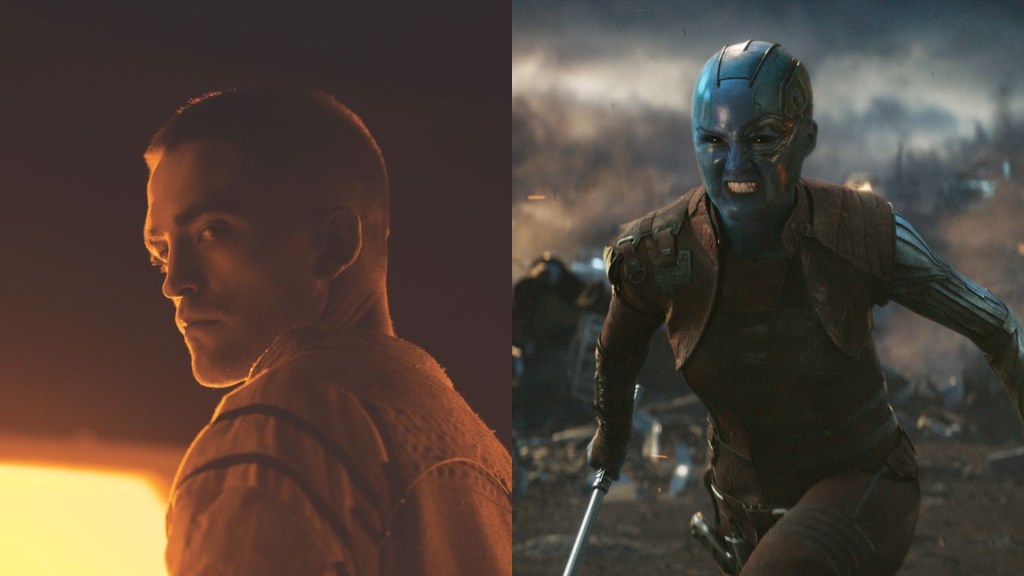
This round of reviews includes “High Life” and “Avengers: Endgame.”
High Life
“The sensation of moving backwards, even though we’re moving forwards—getting further from what’s getting nearer.”
In a conversation with Barry Jenkins for the New York Times, director Claire Denis outlines her view regarding the moral abhorrence of the death penalty as well as the inherent, boundless cruelty of forcing people to wait for execution. In her new film, “High Life,” these thoughts are given long, elliptical form, mapping onto an interstellar expedition the experience of sitting on death row, creating a bleakly rigid purgatory complete with its own expiration date. The film is science-fiction, but there’s something familiarly vacuous at the heart of a system that would sooner send prisoners hurtling towards a black hole in the name of data collection than rehabilitated at home.
“High Life” takes place aboard a vessel on such a mission. Each day, every member of the crew must fulfill the obligations of their role in order to earn an additional twenty-four hours of life support. These roles range from those of pilot and mechanic to that of a pseudo-warden who runs sadistic experiments on the ship’s inhabitants; these experiments bring to the forefront the structural willingness to treat inmates as something that is less than human. Through these dynamics, the inhabitants move as a collective, inexorably closer to their demise.
Denis slowly unravels this waiting period with a deceptively methodical precision, following each thread as it’s pulled from its tangled knot, and the viewers are drawn to each curiosity brought about by a purposefully jarring edit or compositional choice. The film treats time as a finished artwork, conflating that that has happened with that that will happen; it’s a tapestry that Denis’ camera explores with a judicious non-linearity (think of the depiction of time within Christopher Nolan’s “Interstellar” and then sprint with it towards abstraction). Due to this structural decision, the period of incarceration takes on an enveloping sense, feeling both absolutely encompassing in terms of defining the characters’ lives yet entirely arbitrary with regard to their humanity.
One way that movies work to foster empathy is through immersion, and “High Life” is truly transporting. It’s a deeply textural film, conjuring the tangible watery elusiveness of Tarkovsky’s “Solaris” and furthering this resemblance within its flashback projections of the past. These play through a grainy window, seen literally as memories from another world. The overarching focus on liquids—beading, dripping, flowing—registers in the viewer an environmental immediacy, imbuing the characters’ surroundings with a presence that moves beyond sight and into touch.
Additionally, “High Life” contains the plight of the child who was born into this incarceration, condemned alongside her father. She learns what it means to be human as her father helps to interpret errant traces of stray transmissions that find their way to the ship’s monitors in the form of scraps of footage from earth. In a profoundly thoughtful moment, she sees somebody praying and wonders what it must feel like. This attempt to back into meaning, to discover the intangible wonder of an act through introspective imitation is a quintessentially human experience, and here it’s replicated amid the most artificial of upbringings.
To blindly trust that our systems are aligned entirely with what is good is to erase the potential of many people for whom there’s a better path. “High Life” highlights the cognitive dissonance we hold when thinking about who is worthy of redemption.
Grade: A
“High Life” is in theaters now.
Avengers: Endgame
“Trying to get you to stop has been one of the failures of my entire life.”
Considering that the Overton window for spoilers has shifted so starkly towards sensitivity (I’m not saying that’s necessarily a bad thing), it would feel perilously neglectful to not say upfront that I’m going to vaguely “spoil” some of the key plot devices and high-level narrative shaping that goes on within “Avengers: Endgame.” If you still haven’t seen it and you’re worried about that kind of stuff (come on, it’s been three whole days and only most of the showings have been sold out for months), be warned. However, in an interesting little note of irony, I probably would have been quicker to jump fully on-board the movie’s general direction if I were previously made aware of the substantial degree of subversion at play, almost from the get-go.
If “Avengers: Endgame” has taught me one thing, it’s how thoroughly unqualified I am to be talking about it. I’ve seen what can be generously labeled as “most” movies in the Marvel Cinematic Universe (my list of exclusions includes but is not limited to the first and second Thor movies, the first and second Captain America movies, the second and third Iron Man movies, and “Avengers: Age of Ultron”), but I’ll readily admit that there are a few characters for whom I feel nothing because I know nothing. I don’t know who Bucky is and at this point I guess I never will!
That being said, “Avengers: Endgame” was a rousingly entertaining, belligerently messy, wholesomely motivated blockbuster of which I found myself enjoying nearly every minute.
At its core, this is a movie that leans into its most obvious vices, and, in doing so, solves for a great deal of the potential stumbling blocks inherent to tying together a series of 20+ other entries. How could one possibly include a multitude of satisfyingly comprehensive references to old settings and characters while retroactively highlighting key moments within the previous films? Time travel, of course. Where are you going to find a semblance of grounded, interpersonal drama in a series where a talking raccoon plans a heist with a superhero called Ant-Man? By veering into the human ramifications of the prior movie’s rapid swerve into territory previously occupied by “The Leftovers,” HBO’s critical darling of a television series written by the guy who made “Lost.” Obviously.
The best moments of “Avengers: Endgame” are those in which its scale is most readily apparent. I’ll be the first to bemoan the industry’s unimaginative overreliance on the sight of seeing two fantastically futuristic CGI armies clash in “Mount & Blade”-style warfare, but the charge during the film’s climax is flawlessly composed, calling upon a staggering array of characters and landscapes. It answers the “Why?” of the moment so emphatically that it couldn’t matter less that it largely disregards the “How?” This ridiculous culmination also imbues the Avengers’ theme song with a lofty mythical resonance it may have heretofore been lacking.
Granted, all of this success at the expense of moderation doesn’t come without consequence, but I believe to get caught on that is to profoundly miss the point. “Avengers: Endgame” clearly wants viewers to have as much fun as it’s having, and it’s incredibly tough to fault it for that—
—so let’s not.
Grade: B+
“Avengers: Endgame” is in theaters now.
 On the Image
Leave a comment