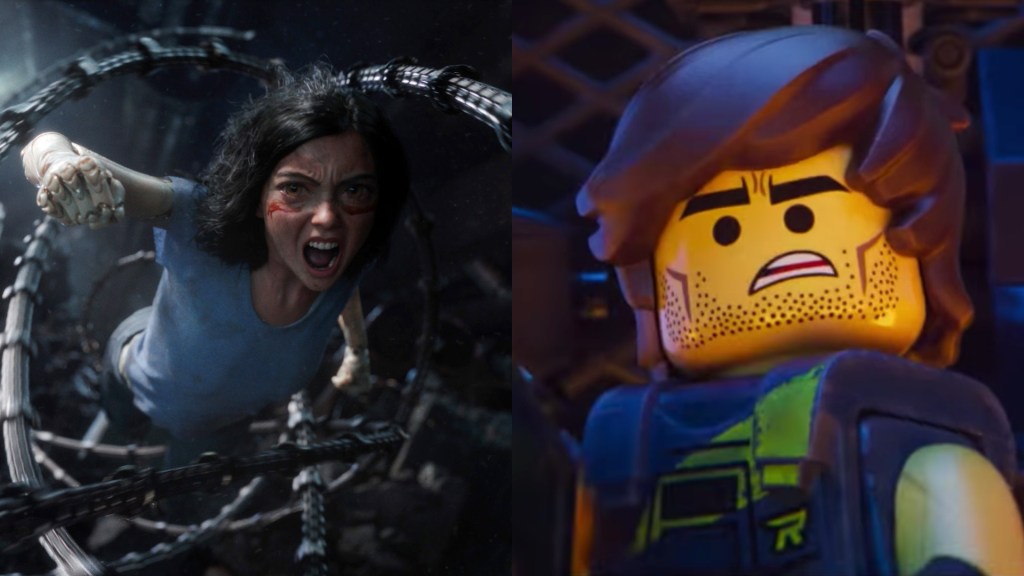
This week’s reviews include “Alita: Battle Angel” and “The Lego Movie 2: The Second Part.”
Alita: Battle Angel
“I don’t mean to be rude, but am I supposed to know you?”
“Alita: Battle Angel” dares to ask the question, “What happens if you take the world of Ridley Scott’s ‘Blade Runner’ and replace its grim atmosphere and philosophical musings with that one racing level from ‘Spy Kids 3-D: Game Over’?”
Unfortunately, it also answers that question.
Directed by Robert Rodriguez and co-written by James Cameron and Laeta Kalogridis, “Alita” follows its like-named cyborg protagonist (Rosa Salazar) from the moment she is found in a scrap heap by Dr. Dyson Ido (Christoph Waltz) as she is rebuilt into a warrior in search of her past. There’s a lot of noise in the narrative, but suffice it to say that it involves a gladiatorial sport called Motorball and a privatized arm of law enforcement comprised of “hunter-warriors” (apparently anybody who wants to be one can just sign-up, which is neat). For what it’s worth, Salazar and Waltz are fine, and Mahershala Ali is even more than that in a role which he manages to make three-dimensional despite the script fighting against him every step of the way.
All movies are constructed as part of an ever-evolving tradition that necessarily entails and encourages levels of reverence for and references to works that come before. However, there’s an interesting, inescapable disconnect between “Alita” and the movies whose shoulders it stands on. Some of the picture’s energies are consumed by attempts to wield the thematic gravitas of classic works of science fiction by evoking their appearances, likely in hopes that viewers then do the work of connecting the dots. While this possibility doesn’t yield nearly the same calamitous implosion in “Alita” as it does in a film like “Kong: Skull Island” (a movie sporting a severely detrimental obsession with “Apocalypse Now!”), it does shine a revealing light on some of the film’s limitations. Namely, it is often eager to pay lip-service to some of the truly intriguing questions posed by its world before promptly abandoning the thread in favor of an installment of its achingly dull romantic subplot.
That “Alita” is uninterested in reaching for anything remotely thoughtful is not an inherent shortcoming—it was only last year that J.A. Bayona’s “Jurassic World: Fallen Kingdom” displayed how effectively a director can convey profoundly thoughtless material in an impressively cinematic manner. However, “Alita” doesn’t manage to fill-in for its vacuity with a striking directorial awareness nor can it skate by on sheer technical craftsmanship. (Sorry, fellow Fallen-Kingdom-heads; it looks like we’re going to have to wait a bit longer before finding this year’s misunderstood genius blockbuster.)
“Alita” also stands as a case example of dissonance between a creator and a work. Through several abjectly strange and borderline uncomfortable moments, it becomes evident that those at the helm of the film might not have been the most readily equipped to navigate certain aspects of the story.
The best thing about this movie is its inclusion of a bounty hunter whose moral code is seemingly centered entirely on whether or not people “love dogs.”
Grade: D+
“Alita: Battle Angel” is in theaters now. But also why are her eyes so big?
The LEGO Movie 2: The Second Part
“Oh no, are we in a musical?”
If any group in film today seems impervious to a stress test, then it’s probably the creative team fronted by Phil Lord and Christopher Miller, whose recent output consists of hits such as “The LEGO Movie,” the “Jump Street” series, and “Spider-Man: Into the Spider-Verse.” Sure, something of theirs was eventually bound to miss the mark, even if only slightly, but the question, “What would a miss from them even look like?” remained.
Now we know, and it’s still pretty damn good.
Despite being one of the duo’s more uneven offerings, “The LEGO Movie 2: The Second Part” is still a mostly fresh, genuinely hilarious continuation of the beloved original. This movie picks up right where everything was left (just like a kid returning to their LEGOs after a break from playing!!!), although it doesn’t take five minutes before the timeline is advanced by five years. Viewers rejoin the boy from the original (Jadon Sand), now going through an edgy, rebellious phase—fully reflected in his new LEGO creation of “Apocalypseburg”—and watch as his party of brick figures confront new challenges presented by an invasion from the “Systar System” (his sister is played by Brooklynn Prince; some may recognize her as the young star of Sean Baker’s “The Florida Project”).
In a ‘meta’ turn (too much so even for Lord and Miller to wrangle), it quickly becomes evident that some of the lessons of the first film didn’t quite take root, both in the scripted narrative and the structure of the movie itself. Unlike the original, where the LEGO adventure was greatly supplemented by the reveal of the world outside, this go-around tries too hard to make the two realities exist as complements. It gets a bit exhausting watching the movie try to provide concurrent justifications for all the animated fun (although Maya Rudolph is obviously fantastic in her moments onscreen as the children’s mother). The biggest problem, though, is that several of the thematic cords which tether the movie’s pathos to its proceedings don’t reach as far as they need to, leading to muddled lessons and an ending that fails to fully cohere.
Ultimately, the movie shares the same infectiously positive spirit of its predecessor, and that does go far alongside the standout vocal cast. Also, one last crucially important note: it’s absolutely worth braving any reservations you may have about the movie simply to see Tiffany Haddish’s character, Queen Watevra Wa’Nabi, perform the excellent musical number, “Not Evil.”
Grade: B
“The LEGO Movie 2: The Second Part” is in theaters now.
 On the Image
Leave a comment