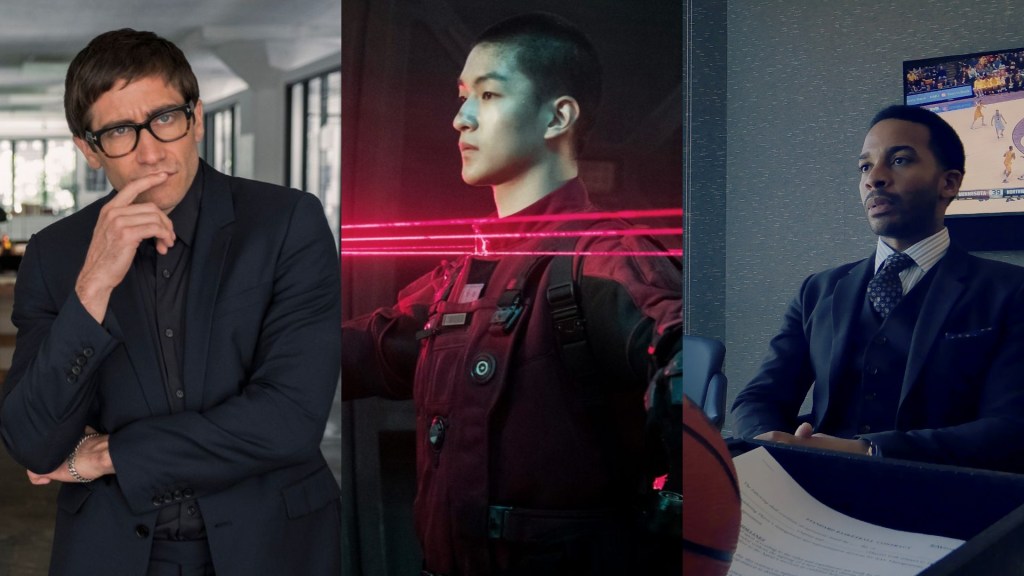
This week’s reviews include “Velvet Buzzsaw,” “The Wandering Earth,” and “High Flying Bird.”
Velvet Buzzsaw
“Imagine having to spend eternity in that.”
“Velvet Buzzsaw” is director Dan Gilroy’s peppy satire of art commerce, dealing both in moments of comedy and thrills. It’s a picture that feels pleasantly fresh if a bit overeager in its editing and shallow in its satirical reach. Its camera, ever curious, lands on some intriguing compositions, but this curiosity leads to a hyperactivity, always seeming to look for the next shot at the expense of its current frame. The color palette is fairly generic, lacking hooks to bind the more disparate scenes together; towards the end there’s an impressively creative moment that takes full advantage of this openness, but it would’ve been great to see more earlier on that front.
Jake Gyllenhaal’s turn as Morf Vandewalt (the name does indeed betray the nature of the role) is a blast for most of the ride, and Toni Collette shows once again why every movie would be significantly better with her in it. Daveed Diggs feels underutilized, but he does deliver one deadpan, monosyllabic reaction that’s so fantastic it single-handedly recharged my (at that point slightly ebbing) attention. Unfortunately, as the narrative progresses, the growing stakes suck some of the oxygen out of the ensemble and crowd out the performances.
Ultimately, “Velvet Buzzsaw” succeeds in being an accessible, mostly compelling riff on a world to which many lack any semblance of exposure, but some of its thrills are overridden by a self-defeating ridiculousness and a lens which doesn’t quite capture the gravity it seeks out.
Oh, and the ending would have been absolutely perfect if it came about a minute sooner. But it doesn’t. So it’s not.
Grade: B-
“Velvet Buzzsaw” is currently streaming on Netflix.
The Wandering Earth
“We have decided to choose hope.”
Director Frant Gwo’s “The Wandering Earth” is a picture vested equally in personal intimacy and cosmic absurdity. This is a balance which inherently lends itself to an unevenness in the presentation of its narrative, but also one that effectively buoys its moments of triumph to operatic heights. The conceit at the heart of the film is that, in response to a rapidly expanding sun which threatens to consume the solar system, humanity has united to turn the earth into a rocket-propelled vessel in the hopes of finding a new home among the stars. Set against this backdrop, the film proceeds across two arcs: the primary one amounts to a turbulent rescue mission of varying scales in a post-apocalyptic tundra, while the other features a man-versus-machine showdown on a space station which seems eager to evoke Stanley Kubrick’s “2001: A Space Odyssey” and Alfonso Cuarón’s “Gravity.”
The longer emotional arcs at play take on a clarity that elevates them above the shot-to-shot consistency of the film’s action, which sometimes falls short of coherence. The screenplay (adapted from a novel by Cixin Liu) doesn’t rush to character-specific revelations, opting instead to allow their progressions to manifest naturally and layer them onto already-climactic moments. Additionally, some viewers may take note of the movie’s topical bent, as it centers on what is essentially a climate-related disaster. It’s heartening to see a film with a fundamentally optimistic take on humanity’s ability to band together in the face of overwhelming odds. Granted, ideally the world reaches the “unite to save the planet” stage well before it becomes necessary to physically move the earth to a different star, but it’s a nice thought.
Also (this isn’t really worth more than a footnote), the English translation of the film has some pretty evident grammatical issues crop up intermittently, including a few clauses that lose their form. No biggie, but you’ll notice.
“The Wandering Earth” is a blockbuster of grand ambition. It doesn’t land every punch it throws, but it’s at its most effective in its biggest moments.
Grade: B-
“The Wandering Earth” is in select theaters now.
High Flying Bird
“What you all saw on your smartphones and tablets… It was raw, it was palpable, and it was real.”
Written by Tarell Alvin McCraney (of “Moonlight” fame) and directed by Steven Soderbergh, “High Flying Bird” follows an NBA agent (André Holland) and the league’s most recent number one draft pick (Melvin Gregg) as they navigate a regular season lockout. An energetic, dialogue-centric picture, its narrative emerges from the staccato needlework of the film’s lively spoken encounters. The editing is overtly impressive without being distracting, as the cuts cooperate with and contribute to its conversational cadence by helping to weave together the dispute between the parties at-odds in the strike. Holland delivers a brilliant performance as a professional who has to juggle dissonant priorities while improvising ways to keep his clients out of jeopardy.
Following in the footsteps of Soderbergh’s last picture, “Unsane,” “High Flying Bird” is shot entirely on an iPhone. The decision to employ this conspicuously mobile cinematographic format is much more than a gimmick. It pulls a fresh, modern sheen from the environment, lending it a sense of kinetic immediacy, and viewers will feel that they are very much present, sharing the screen with characters.
All of these traits cohere to illustrate the inherently uneven nature of its core conflict. Urgency and the subsequent impetus to settle for less will disproportionately impact the worker…
Unless they (and their agents) can find new forms of leverage.
Grade: B+
“High Flying Bird” is currently streaming on Netflix.
 On the Image
Leave a comment