“Movement is never mute. It is a language. It’s a series of energetic shapes written in the air like words forming sentences. Like poems. Like prayers.”
In a moment, a film can find definition, garner condemnation, or stake a claim to redemption. What follows is a list of what I believe to be the ten best movie moments of the last year. Although I’ve tried to work around sensitive plot information, the body paragraphs of this piece may contain spoilers, so proceed with appropriate caution beyond the numbered entries.
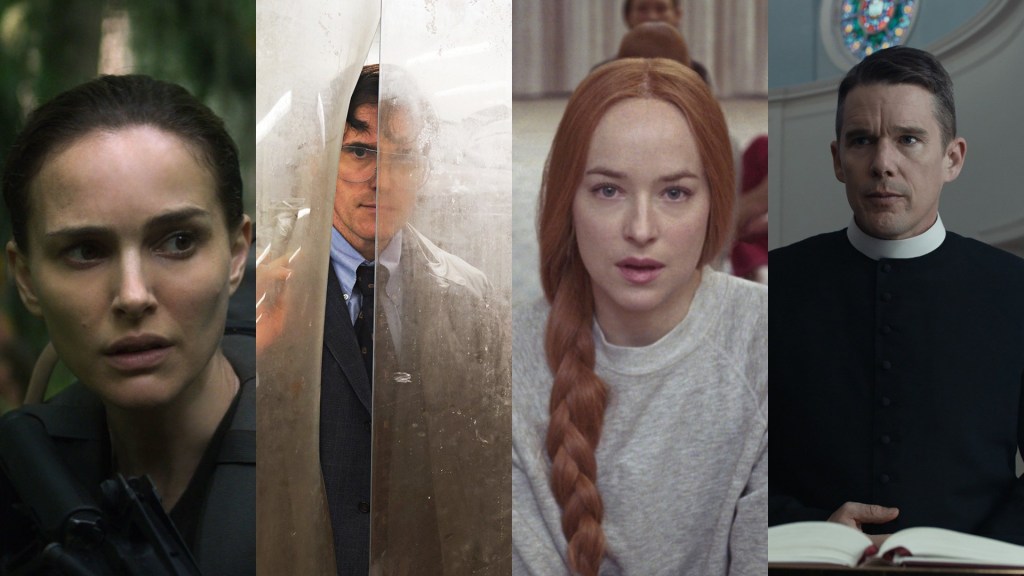
10. Magical Mystery Tour from “First Reformed”
Reverend Toller (Ethan Hawke) is the ailing caretaker of a small church in Stonebridge, New York; his body is in a state of physical declination and his mind is tormented by a smothering sense of dread. Although he is largely relegated to the periphery of society, his is the restless heart at the center of Paul Schraeder’s “First Reformed.” This is a deeply spiritual film that demonstrates the limitations inherent to the human desire for reconciliation. Toller comes to see himself reflected in a world ravaged by humanity’s negligence, and this recognition forces tenets of his faith into contest. “Wisdom,” he says, “is holding two contradictory truths in our mind simultaneously: hope and despair,” although it’s not clear that he’s convinced even himself of this construction.
One night, Mary (Amanda Seyfried) comes to Toller’s residence and asks if he will help her partake in a calming personal ritual that she used to perform with her late husband. He agrees, and, in a moment of platonic physical intimacy, he lies down on the floor and she lies on top of him. Slowly and steadily, the two appear to float, and Schraeder’s camera transcends the physical space of the room, taking the pairing on a hypnotic flight over vistas of great natural beauty. Suddenly, the tone of the flight shifts, and the earth beneath them is polluted by landfills and factories. Toller’s expression turns to one of discomfort as he and Mary slide uneasily out of focus, leaving just the imagery of a broken Earth onscreen.
9. Gunpoint from “Blindspotting”
The profoundly lyrical nature of Carlos López Estrada’s “Blindspotting” is one that consciously restrains itself, forming a simmering undercurrent that quietly runs through and unites every scene with a potential to erupt into a maximalist display of poetic passion. In this sense, the film submits itself to the power of its protagonist, Collin (Daveed Diggs). Mere days away from the end of his probation, Collin is stopped at a red light when he sees a policeman shoot and kill an unarmed black man at the intersection. Viewers watch as the structural racism of the U.S. justice system forces Collin to suppress his trauma while living in a society that seems to flaunt the disadvantages that it foists upon him.
The entirety of “Blindspotting” builds to a scene that boils-over into a fascinating fusion of swift musicality and dramatic tension. As fate would have it, Collin, working for a moving company, finds himself in the home of the policeman from the intersection. In a painfully emotional confrontation, Collin draws a gun and delivers a rap that grows from spoken word into a driven verse whose momentum seems to pull the diegetic sounds of the world together into a beat.
“The difference between you and me is…” Collin concludes, “I ain’t no killer…
“I ain’t no killer.”
8. In Darkness, Light from “You Were Never Really Here”
Lynne Ramsay’s direction imbues “You Were Never Really Here” with a sense of elegiac rhythm. Its cadence drifts with an elusive purpose as Joe’s (Joaquin Phoenix) consciousness is refracted through the camera and ordered on the screen like shattered ornaments rearranged into a stained glass window. One moment stands out as being a cogent crystallization of this sensibility while also containing one of the most remarkable shots of the year.
Following the death of his mother at the hands of government agents, Joe travels to a lake in order to perform a water burial. He walks with a grim finality into the water, holding her body in his arms, and together they sink below the surface. Viewers follow him underwater as the camera cuts to a wide shot showing their two bodies intersecting like a cross, suspended in the water as a single ray of light shines behind them, casting their figures in silhouette. As he lets go of his mother’s body and watches her fall into the unseeable depths, it gradually becomes evident that he has no intention of reemerging. Before running out of breath, he is struck with a vision that stirs his soul into action. He removes several large stones from his pockets and swims back towards the surface, saving much more than his own life in the process.
7. Doppelganger from “Annihilation”
In many ways, Alex Garland’s “Annihilation” follows in the footsteps of his directorial debut, “Ex Machina.” It’s a heady work of science fiction that doesn’t pretend to have nearly as many answers as it does questions. Its tether to credibility relies largely on the performances of a small ensemble cast, as a group of characters find themselves isolated from the world. It crescendos to peaks of severe tension, exacerbated by the inclusion of unknown, unpredictable beings. However, what these similarities fail to capture is the lofty, staggering insanity of “Annihilation’s” climax, and how something so thoroughly consistent with its painstakingly placed trail of thematic bread crumbs can feel so entirely out of left field.
After a harrowing journey into “the shimmer,” an extraterrestrial boundary radiating and expanding from an impact event on the gulf coast, Lena (Natalie Portman) arrives at its epicenter and finds a lighthouse surrounded by glass trees. Once inside the building, she proceeds to climb down a mysterious, foreboding hole in the floor, which opens up to an organic-looking chamber. At its center, Lena sees Ventress (Jennifer Jason Leigh), the last surviving member of her team. After a disquieting exchange, and with an alarming resignation, Ventress declares, “Annihilation,” before violently disintegrating into streams of light.
A portal opens, a doppelganger emerges, and Lena comes face-to-face with a chillingly recognizable version of herself.
6. Goodbye from “Leave No Trace”
There are very few spinning plates in Debra Granik’s “Leave No Trace,” a quality that lends the picture a deceptive air of simplicity. Its focus rests entirely on the shoulders of Will and Tom (Ben Foster and Thomasin McKenzie), a father and daughter who live off the grid, detached from society but for occasional trips into town to gather essentials that help them sustain their lifestyle. Will is a war veteran who suffers from PTSD, a tragic embodiment of how the U.S. fails its servicemen and women when they return home. Tom fully embraces the only life she knows, the one that Will helps to provide for her, but she finds that she doesn’t share his antipathy towards a more conventional modern lifestyle. More than this, she comes to treasure the fleeting social bonds she creates with outsiders throughout their journey.
The film’s final exchange casts a light on the complete extent of its emotional depth forged so deftly by Granik, Foster, and McKenzie. It’s a sensitive, devastating illustration of the gravity of mental health concerns, and how they can create an insurmountable gulf between two people who genuinely love one another more than anything else.
“Leave No Trace” is a beautiful, essential picture.
5. Guilt from “Hereditary”
Midway through Ari Aster’s “Hereditary,” a film that is plenty horrifying in every conventional right, a key character is killed in a brutal and shocking instant. The death, however, is not a blameless one. It’s the direct result of one character’s negligence while driving home from a party in their mother’s car. Directly following the incident, in a state of irrepressible shock and unable to properly process what just happened, the driver silently finishes the trip home and slinks into bed, the body of the victim still lying in the back seat of the car. The next morning, following a traumatic and sleepless night, Aster’s camera stays trained on the driver’s expression as it picks up audio of the household’s morning movements. Inevitably, the sequence culminates in a terrible and traumatic moment of discovery.
I’m not particularly inclined to expand on this any further. This series is tailored to prey on anxieties, and I absolutely hated sitting through it. It bothered me so much that I will likely never watch this movie again.
Naturally, I feel as though I had no choice but to include it on this list.
4. Facing the Waves from “Roma”
Alfonso Cuarón’s “Roma” is a masterwork of empathetic filmmaking. Fusing a slice-of-life sensibility with massive set pieces that evoke the feel of an epic odyssey, the movie follows Cleo, a young woman working as a maid for a middle-class family in Mexico City. Near the end of the film, as Cleo accompanies the family on a trip to the beach, she hears the cries of the children as they struggle to stay afloat amid increasingly dangerous waves.
I don’t actually want to get into the details of this moment, as it relies so strongly and successfully on the experience of connecting with the film’s preceding hours. It pulls heartbreaking pathos from Cleo’s prior experiences while also standing as a technical marvel; viewers are quickly reminded that Cuarón is the same director who orchestrated the visceral impact of 2013’s “Gravity.”
“Roma” is on Netflix, so try to carve-out some time to watch it before the Oscars on February 24th.
3. Epilogue from “The House That Jack Built”
The finale of “The House that Jack Built” is something that could only have been accomplished by an auteur that is, in actuality, probably a little too confident. After hours of focusing on visions of horrific, unconscionable violence perpetrated by the serial-killer “Jack” (Matt Dillon), director Lars von Trier flips a switch and thrusts the viewer into an Alighierian descent into Hell. Shepherded by Virgil (Bruno Ganz), with whom Jack has been in constant dialogue throughout the film, viewers bear witness to an exceedingly patient and filmically elevated tour of the underworld that has at least as much in common with Andrei Tarkovsky’s “Stalker” as it does with the preceding two hours.
Lars von Trier’s willingness to swing the pendulum between an uncomfortably intimate handheld camera and a hyper-formalized panorama, uncanny in its not-quite-static composition, is truly astonishing to behold. In-practice it can make a viewer feel as though they are being ripped out of and then forced to observe a painting, one of which they didn’t even realize they were previously part and parcel. It’s the difference between a film fully embodying the perspective of its characters and a film that trades the invisible hand of the artist for a directorial megaphone—vastly different sensibilities, to be sure—but von Trier is somehow able to balance the two within a single feature.
I can’t comfortably recommend that anybody watch “The House That Jack Built,” but those that do will be privy to one of the year’s best moments—and one of its best movies, too.
2. Unmade from “Suspiria”
Luca Guadagnino’s “Suspiria,” a reimagining of Dario Argento’s 1977 cult movie of the same name, seems to run straight away from the original’s most enduring qualities. Instead of a vivid technicolor fortress of dance and plague, the Guadagnino film takes place in an imposingly drab facility that seems to leech its inhabitants of their vitality. Where there used to be a tantalizing mystery sparked by an all-too-visible display of graphic violence, there is now a quiet web of deception so deep and convoluted that it seems designed to snuff-out intrigue at its roots. In the place of Goblin’s pulse-poundingly urgent and evocatively surreal score is an entrancing soundtrack by Radiohead frontman Thom Yorke that methodically disarms the viewer and drags them out of lucidity.
This assertion of independence from historical expectation pays-off spectacularly during the film’s climax. In a ceremonial chamber beneath the dance academy, a scene commences that is as deeply inexplicable as it is luridly imaginative, representing another departure from the classic picture’s comparatively tidy ending. A coven is revealed, power dynamics are wrenched, and human bodies are razed by an ethereal force. The screen itself seems to react unsteadily to the display; the frame rate stutters as the sound of Thom Yorke’s “Unmade” rolls over viewers, pinning them against their seats. Befittingly, amid this frenzy, a single color—red—finally bursts free of its suppressive moorings before enveloping the screen, threatening to drown the proceedings entirely beneath its tide.
1. Epilogue from “BlacKkKlansman”
The ending of “BlacKkKlansman” is one of the most powerfully persuasive cinematic sequences that I’ve ever seen. With it, Spike Lee draws a line through history and connects our contemporary plight to ugly forces that have always lied just beyond the beamingly proud sheen of the American dream.
From my full review of “BlacKkKlansman,” an excerpt describing the film’s epilogue:
In a moment that initially feels like a coda to the film’s central narrative, Ron and Patrice are jarred from a discussion by a menacing knock at the door. The mood suddenly balancing on the edge of a razor, they draw their guns and move to answer.
The door opens and the viewer’s perspective shifts as the camera cuts to face Ron and Patrice standing in the hallway outside the room. The camera slides backwards, Ron and Patrice remaining static at its center, and it seems to pull them both towards the screen, into the modern world. They look past the lens, their sights fixed on something in the distance. Another cut reveals what they see: beyond a window at the end of the hall, a large cross is burning. Men in white hoods surround the ceremonial blaze, fervidly shouting white supremacist chants into the night.
With a swift and chilling ease, these sights and sounds melt into the “Unite the Right” rally in Charlottesville, Virgina one year ago.
Viewers are then shown a searingly direct montage in which Donald Trump defends white supremacists after the fatal events of that weekend. Because both sides were violent, he claims, both sides were of equal moral standing. He suggests that those opposing bald-faced fascism and purveyors of racist violence are no better than the fascism and racism that they oppose. Both sides, he said, had “very fine people.”
Cut to David Duke, the real man portrayed in the film, talking to a crowd of people about this moment and invoking the president by name. At this point, there is no question that white supremacist groups and leaders have adopted this president as one of their own. It’s evident that he has emboldened these movements with his rhetoric and policy positions and that he has repeatedly refused to convincingly disavow their support. This hatred is not just an abstract footnote of his presidency; it’s a core aspect of its identity, and it has dire consequences.
Raw footage of the violence sparked by white supremacists flashes on the screen, culminating with the terrorist attack that took the life of activist Heather Heyer. The tragedy and horror of the moment is stark and inescapable. The film ends in silent commemoration with the final words,
“Rest in Power.”
 On the Image
Leave a comment