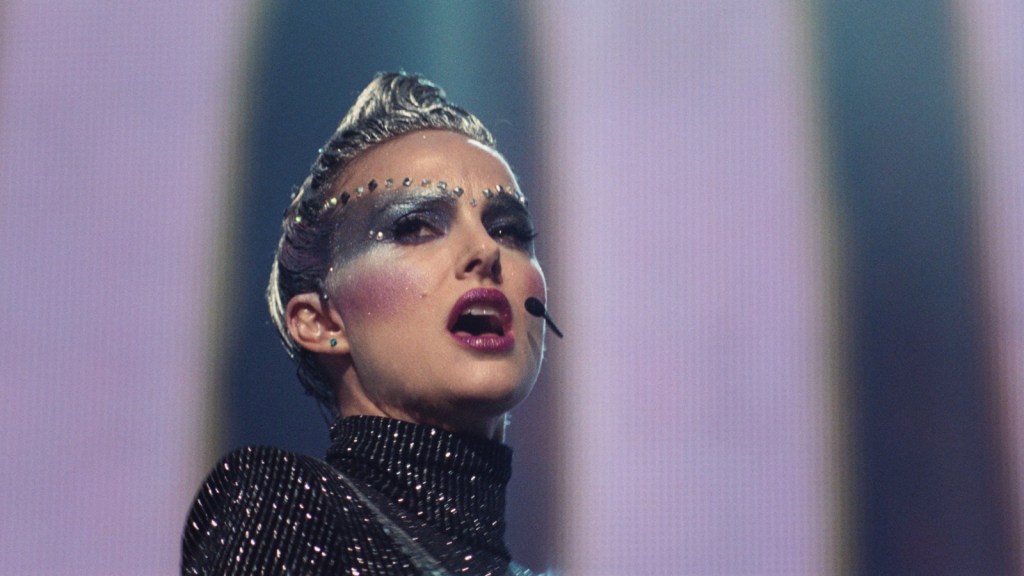
“Tonight we’re going to bring it back to where it all began.”
“Vox Lux” stands as a twenty-first century opus by way of near-inscrutable construction, its foundation built along mercurial gradients of fame and infamy, of beauty and horror, of harrowing guilt and unbounded narcissism, and of sacrifice and self-destruction.
In relief on its exterior surface you’ll find a high-concept narrative which might suggest an otherwise-absent allegiance to genre-fare, but internally it’s supported by separate events, largely isolated without arc, situated uneasily in the extremities of the aforementioned spectra. Pillars of sisterhood, artistry, and communal inspiration accompany those of betrayal, substance abuse, and mass-murder. Although these contradictions make for a confounding blueprint and cast a disorienting spell on the screen, fortunately, somehow, the entire work manages to stand upright without caving-in under its own weight.
“Vox Lux” follows the life of Celeste (portrayed first by Raffey Cassidy and then by Natalie Portman), a fictional pop-star whose ascent runs parallel to the onset of the twenty-first century. Viewers see as her career is born from immense tragedy; as a survivor of a shooting at her school, she writes a song and performs it at a vigil held to commemorate her fallen classmates. After this performance is picked up by the media and spread throughout the country, Celeste follows a rapid trajectory into stardom befitting her name. Helping to illuminate certain details of Celeste’s life is Willem Dafoe as the film’s narrator, very apparently uninterested in shepherding viewers through the work, but tasked with doing so nonetheless.
What keeps this almost comically-distanced narration from feeling superfluous (or even “pretentious”) is how director Brady Corbet structures the movie. To say that “Vox Lux” tells Celeste’s story is to too-liberally lean on the word “tells.” It is not concerned with stories per se as much as it is with their beginnings and endings. Dafoe’s delivery which might risk coming across rather blithely instead takes on an almost-documentary-esque sensibility as he provides welcome context about Celeste’s life that viewers don’t get to see.
The film is essentially divided into two halves. The first stretch follows young Celeste and documents events around the turn of the century. It starts with an unblinking, heartrending depiction of the tragedy at Celeste’s school before proceeding to demonstrate what becomes of her new life, complete with its own onslaught of exhausting rigors and perilous temptations. The second half of the film is likewise anchored by an act of horrific violence, as gunmen open fire on a European beach, wearing masks featured in one of Celeste’s music videos. She is then tasked with responding to this link between her art and an act of unspeakable terror, all while attempting to promote her new album (the namesake of the film) and subsequent tour.
Natalie Portman’s turn as Celeste has proven to be as polarizing as the picture itself; the only thing that everybody seems to agree on is the amount of acting that goes into the role. This performance draws from levels of emotional maximalism and excess that approach operatic heights, and it inherently walks an incredibly fine-line in doing so. Acting on the stage requires a performer to play to every seat in an auditorium, and while matters such as nuance and subtlety are certainly not forgotten in theater, in order to be properly communicated their signals must be magnified in a rather oxymoronic fashion. Somewhere along the line, between the early years of her fame and where viewers find her years later, Celeste began to constantly perform for the world. This consideration lies at the heart of Portman’s pop-star, as viewers get the sense that she’ll turn to song, monologue, or confrontation—whatever it takes—to keep the silence at bay.
One largely unseen benefit of “Vox Lux’s” deliberately static structure is the ample room it provides for the music contained within to resonate. Much like the film’s distinct two-part composition, the soundtrack is divided between pop music as performed by Celeste (and written by Sia) and an ice-cold score by Scott Walker (the profoundly accomplished musician, not the profoundly unethical governor of Wisconsin who just sabotaged the state’s executive branch before ceding the office).
Walker’s score reminded me almost immediately of Mica Levy’s haunting work on a separate Natalie Portman project, “Jackie.” While less ambitious in the establishment of motif and its willingness to drive a scene, Walker’s work is similar in its use of a stirring, sinister undercurrent of strings to relate initially disparate panoramas by infusing them with the same overarching sense of dread. It’s an impressive score when taken within the context of the film, though it likely won’t be garnering many year-end accolades on its own.
Sia’s contributions are some of the more publicized aspects of the film, as the artist penned a total of nine original songs for the final soundtrack, featuring four performances by Raffey Cassidy and six by Natalie Portman. The standout track is “Wrapped Up,” the song that young Celeste writes for the quiet memorial service and that, years later, she performs for a massive, clamoring audience of her fans. Its chorus is comprised of the following lines:
So teach me, show me all you’ve got
And in your words, I will be wrapped up
Speak to me, you’re my last hope
And I will say nothing and listen to your love
In the film’s epilogue, Celeste’s delivery of these words feels like an attempt to reach backwards through time, and herein lies the most extraordinary and devastating success of “Vox Lux.” The camera, trained on Celeste’s performance, captures her oft-repressed pain and vulnerability, and through this moment viewers see the same soul that sang at the vigil almost two decades prior.
It’s in this connection between the two versions of “Wrapped Up” that all of Corbet’s and Portman’s gambits either do or don’t pay-off for a viewer, and the movie’s polarized reception across audience and critical circles alike probably owes a bit to this overt reliance on a single one of its facets. Granted, the relationship exists outside of the song, but Corbet’s insistence on driving a wedge of negative space between the two versions of Celeste presented in the picture leads naturally to a want for something tangible.
At its heart, “Vox Lux” is a film about the presence of these abstract connections, though it is decidedly not about deciphering them. It illustrates that there exists some sort of connective tissue between fame and infamy, between beauty and horror, between harrowing guilt and unbounded narcissism, and between sacrifice and self-destruction. It posits that even if these bonds are inexplicable—
—they’re not unknowable.
Grade: A
 On the Image
Leave a comment