“But you also had people that were very fine people, on both sides.”
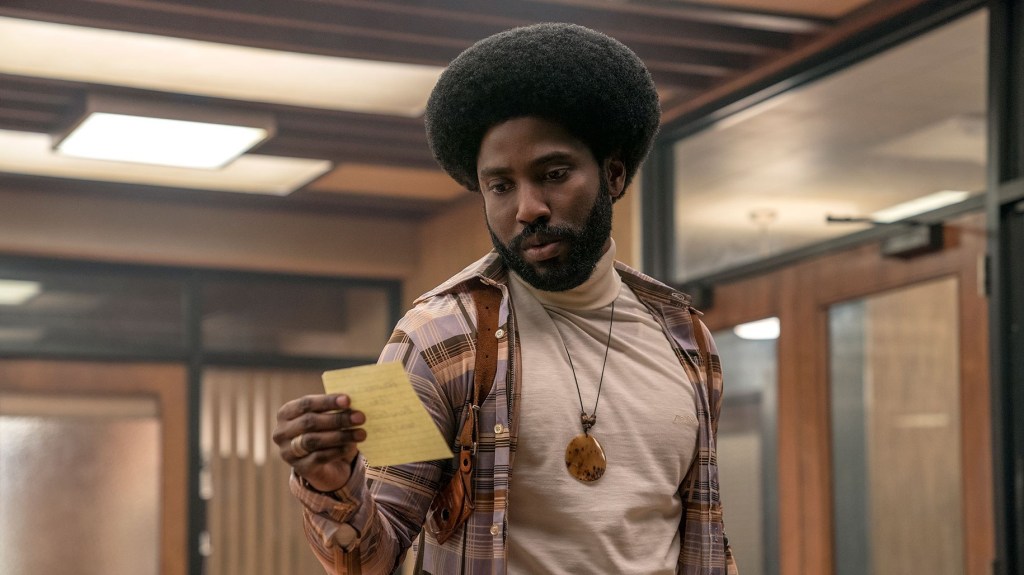
Spike Lee’s “BlacKkKlansman” doesn’t have time for equivocation, bad-faith arguments, or lies. It’s here for a reason; its frames convey truths in the form of a robustly visual parallelism, its roots firmly planted in the racism integral to American history. It’s immediate, confronting, and personal; its characters stare constantly and unabashedly into the lens, unrelenting in their willingness to meet the viewer’s gaze. It’s earnestly engaging; its connections and lessons offer genuine answers to a questioning viewer, while also preempting a litany of reactionary counterpoints. It’s grounded in an essential morality that many today actively try to obfuscate and confuse; its north is constant and true.
It’s one of the best, most vital movies of 2018.
“BlacKkKlansman” tells the story of Ron Stallworth, the first black police officer of the Colorado Springs Police Department, and how he successfully infiltrated the KKK. It’s based on Stallworth’s 2014 memoir, in which he detailed a two-sided strategy. He would personally handle most of the dealings with ‘The Organization’ (the KKK’s preferred moniker) over the phone, and, when in-person contact was required, he would send another detective (a white man) to pose as “Ron Stallworth.” At one point, he even made a call to David Duke, the leader of the KKK, who guaranteed to personally see to it that Stallworth receive his membership card.
Watching the film for the first time, it’s tough not to be swept up in the verve of Lee’s exuberantly deliberate direction, as the momentum that ushers viewers from scene to scene strikes a chord as classically cinematic as it is authentic. The individual performances by its leading trio of John David Washington, Adam Driver, and Laura Harrier are strong and subdued; Washington seems primed to emerge as a veritable, scene-stealing force. Chayse Irvin (one of the cinematographers on Beyonce’s “Lemonade”) captures imagery that is unfailingly human within the bounds of an uncompromising frame. Layered on-top of all this, the score by Terence Blanchard is one of the year’s best.
All of this adds up to a virtuosic coherence that would normally command at least a share of the popular discussion in the days following a film’s major release, but “BlacKkKlansman” has instead struck an invaluable nerve that has largely shifted the critical discussion of the film from its technical prowess to its thematic urgency.
Spike Lee takes full advantage of film’s affinity for parallel construction, building contrasting scenes on top of one another and thus letting them engage in a dialogue. Towards the end of the film, he intercuts a KKK ceremony with an immensely sobering monologue delivered by the character Jerome Turner (played by Harry Belafonte). Within the former, white men go through rites and are initiated before sitting down together and watching D. W. Griffith’s film, “The Birth of a Nation,” applauding its overt racism as well as the way that it lionizes the KKK. Meanwhile, before a group of black men and women, Turner details his personal experience witnessing the lynching of Jesse Washington. (Although Turner seems to be a character created for the film, the event he describes is horrifically real.)
At first, Lee lingers between cuts, allowing the scenes to grow on their own and resonate individually. This resonance eventually turns into a sharp dissonance, as the cuts start to come closer together, the vivid contrasts at play fully engaging one another. The moments crescendo, the edits between them take on a musical percussiveness, until, roused by the imagery onscreen, the KKK members jump to their feet to yell, repeatedly, the phrase “White Power” while striking and holding the Nazi salute. Seconds later, as Turner finishes his telling, the crowd of listeners in the room raise their fists in the air and call out “Black Power” in solidarity.
This sequence is a potent crystallization of “BlacKkKlansman’s” thematic weight, and Spike Lee uses it demonstrate the insidious power of false equivalence. Words and phrases have meanings that evolve over time; they can be distorted or amplified by historical baggage. Lee illustrates that equating the phrases of “White Power” and “Black Power” is to equate a tool of oppression with one of liberation. This point echoes across the decades and permeates the discourse today. Among countless briefer discussions that occur on talk shows and social media, larger debates such as the one surrounding “Black Lives Matter” reflect one side’s willingness to turn a blind eye to essential context. By ripping the dialogue away from its history and away from the power structures that exist today, the discussion devolves to one of semantics and opinion, much easier for someone to brush aside if the conversation makes them uncomfortable. As a result, those who have to live with an inherently unjust system and those who fight to change it have to work even harder to be heard.
On Saturday morning, the country woke up to the following tweet from the president of the United States:
The word choice of “all types of racism” isn’t an accident. It’s an assertion built on bad faith—on the false equivalence that Lee directly addresses with the film. It distracts from the true heart of the issue and thus serves to reinforce the status quo.
Epilogue details ahead; best to read after viewing or if you’re not planning to see the film.
In a moment that initially feels like a coda to the film’s central narrative, Ron and Patrice are jarred from a discussion by a threatening knock at the door. The mood suddenly balancing on the edge of a razor, they draw their guns and move to answer.
The door opens and the viewer’s perspective shifts as the camera cuts to face Ron and Patrice standing in the hallway outside the room. The camera slides backwards, Ron and Patrice remaining static at its center, and it seems to pull them both towards the screen, into the modern world. They look past the lens, their sights fixed on something in the distance. Another cut reveals what they see: beyond a window at the end of the hall, a large cross is burning in the distance. Men in white hoods surround the ceremonial blaze, fervidly shouting white supremacist chants into the night.
With a swift and chilling ease, these sights and sounds melt into the “Unite the Right” rally in Charlottesville, Virgina one year ago.
Viewers are then shown a searingly direct montage in which Donald Trump defends white supremacists after the fatal events of that weekend. Because both sides were violent, he claims, both sides were of equal moral standing. He suggests that those opposing bald-faced fascism and purveyors of racist violence are no better than the fascism and racism that they oppose. Both sides, he said, had “very fine people.”
Cut to David Duke, the real man portrayed in the film, talking to a crowd of people about this moment and invoking the president by name. At this point, there is no question that white supremacist groups and leaders have adopted this president as one of their own. It’s evident that he has emboldened these movements with his rhetoric and policy positions and that he has repeatedly refused to convincingly disavow their support. This hatred is not just an abstract footnote of his presidency; it’s a core aspect of its identity, and it has dire consequences.
Raw footage of the violence sparked by white supremacists flashes on the screen, culminating with the terrorist attack that took the life of activist Heather Heyer. The tragedy and horror of the moment is stark and inescapable. The film ends in silent commemoration with the final words, “Rest in Power.”
“BlacKkKlansman” is in theaters now.
Grade: A
 On the Image
Leave a comment