“How can we see anything but the fiery shadows in the cave if we’re never allowed to move our heads?”
Ramin Bahrani’s adaptation of Ray Bradbury’s “Fahrenheit 451” depicts a world oppressed by the opiate of its own choosing: an omnipresent interconnectedness not more than a few stone’s throws away from our current technological capabilities. “Yuxie,” an artificial intelligence hub that bears a striking resemblance to Amazon’s “Alexa” or Google’s “Home” devices, can seemingly be found (or finding you) in every nook and cranny of this world, indiscriminately piping information directly to the state, a fresh but troublingly familiar power which emerged following America’s “second” civil war. The fire department (tasked not with putting out fires, but with setting them) serves as the predominant arm of law enforcement, fueling the great conflagration that looks to consume books, movies, and anything else that can foster independent thought. Nearly all works of art are labeled as “graffiti,” inherently conflating them with acts of vandalism. Physical books are rare, scattered sparsely like embers after a bonfire, and knowledge of their contents are limited to societal outcasts called “Eels.”
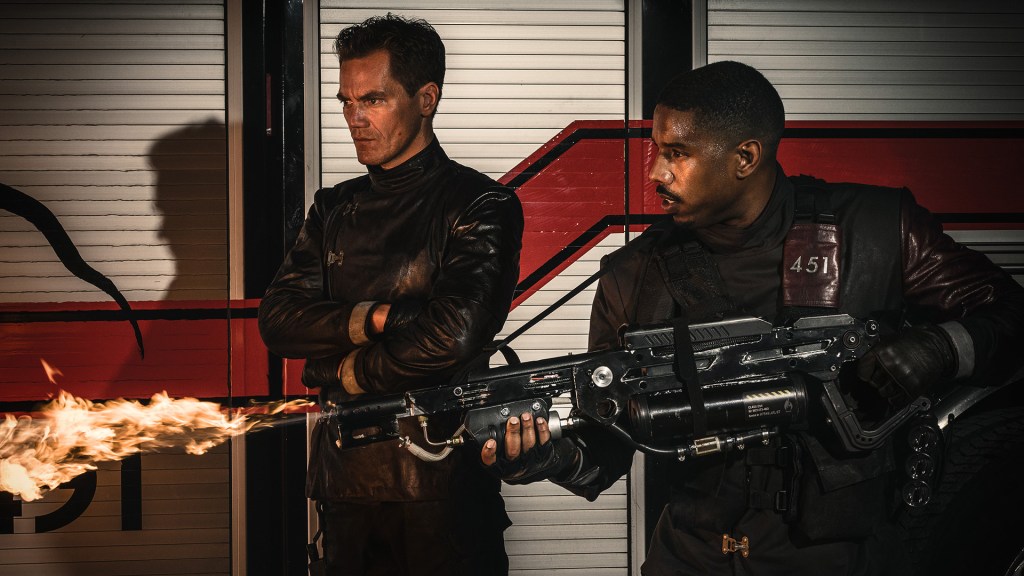
“Fahrenheit 451” has to navigate the pitfalls intrinsic to an IP with an already-established place within pop culture, namely risking a dull redundancy within its exposition while combating the multitude of preconceptions that people will surely carry into their experiences. Perhaps due to these concerns, the film runs lean and quick through much of its first act, being a bit too economical with its pacing, and its initial aesthetic is heavily reminiscent of an episode of “Black Mirror.” (Is this even a valid complaint? How many times has this nitpick been levied over the last few years?) However, as the plot begins to gain traction, things coalesce into something wholly compelling on its own merits. Bahrani builds this world from the limited perspective of our protagonist, fireman Guy Montag (Michael B. Jordan), a shrewd move that invites an authentic sense of mystery into the narrative. Montag and his commanding officer, Beatty (Michael Shannon), are operatives with a strictly regional jurisdiction, so there are many questions pertaining to the nature of the world that go unanswered. As Montag struggles to break from the stifling order of society, we learn more about him through his dreams, specifically of one traumatic, formative moment.
Deprived of foundational works of art, the discourse in this particular dystopia is dreary and sterile, lacking musicality and subtext. This makes it all the more surprising that, in a conversation with Montag, Beatty paraphrases Plato’s “Allegory of the Cave,” an allusion which flickers onscreen for a subtle, brief instant, but its ideas course through the entirety of the film, penetrating its very DNA. The allegory is centered on people who are forced into a single, biased perspective; for their entire lives, the only things they’ve been able to see are shadows cast on a wall in front of them. Shadows, by their very nature, aren’t anything themselves, but rather the absence of something else. These people know of no other vision; the shadows are tantamount to their conceptions of reality. From this initial conceit, the allegory details various forms of liberation, from turning around and finally observing the source of the shadows, to leaving the cave entirely and discovering the sun. No degree of liberation, however, allows them to transcend their humanity, as each layer of understanding serves to unveil even more questions than it answers.
The film is far from the first dystopian work to run with Plato’s tale on a textual level (“The Matrix” comes promptly to mind), but it thrives amidst a mutual textural tool-set. As Plato talks of fire as an agent of deception, so does Bradbury, and Bahrani gives ample screen-time to the novel’s famous book-burnings. Mirroring the progression of the allegory, cinematographer Kramer Morgenthau ensures that these fires provide the only natural light in the film’s early-to-mid stages. As art succumbs to the fire and slowly disappears from society’s consciousness, so too does society lose its complexities, its ambiguities, and even its shades of color. Amidst this regression, people find themselves trapped in a city inside a cave, knowing only the shadows of human potential.
In a chillingly sinister and egotistic appropriation and distortion of Helen Keller’s words, Beatty, a man who knowingly wields great power over the lives of others, claims, “I would rather walk with my brother in the darkness than go alone in the light.” The parallels to today are immediate, sharp, and damning, and speak clearly to a fundamental lack of courage to do what’s right coupled with a dangerous affinity for warping historical fact. All of this is couched in a sickening self-awareness and an eagerness to hide behind the words of heroes.
When it comes to those who stand in the way of empathy, art, and love, should we be more concerned about those who can’t turn their heads from the shadows?
Or those who won’t?
“Fahrenheit 451” is now streaming on HBO.
Grade: B+
 On the Image
Leave a comment