“We are what they grow beyond.”
It’s become standard practice for the newest installments of long-running blockbuster franchises to not only tell their own stories, but for them to deliver their own perspectives on the states of their sagas, and Star Wars is no exception. “The Last Jedi” is a big, messy, beautiful union of many things: Light. Darkness. Innovation. Tradition. Cohesion. Contradiction.
As a lesson in self-discovery, Luke asks an aspiring Rey to reach out with her feelings and describe what she sees. She answers with a series of ideas that relate to each other only in opposition. What she’s feeling is not simply these individual components, but rather the energy between them that allows them to coexist.
Balance.
The word itself, to some extent, implies moderation, though few would accuse “The Last Jedi” of being too moderate. This is a massive movie, but also an intimate one. An oft-touted line of defense for massive studio pictures is that it just isn’t feasible to expect a coherent result due to the sheer scale of production and, subsequently, how many sets of fingerprints wind up onscreen. Coherence in movies, however, isn’t as simple a dichotomy as this defense would suggest. In fact, Rian Johnson’s latest picture is a shining example of the idea that certain types of coherence, those tied to emotional honesty and resonance, can overcome relatively minor issues like plot contrivances. It matters less that certain things go unexplained, whether having to do with certain backstories or narrative conveniences, and more that character arcs are legible and that emotional beats are properly developed.
Kylo Ren, the character responsible for the call to “Let the past die,” has been repeatedly pointed to as the onscreen stand-in for the film itself. I dont find this to be a particularly apt analogy, for “The Last Jedi” harbors no ill-will towards the past, and certainly doesn’t seek to destroy it. That being said, it’s also not akin to a star-struck Rey from the final scene of “The Force Awakens,” waiting for heroes from the past to reemerge and fight the battles of today. The key to its relationship with the existing Star Wars canon is, appropriately, balance. It’s obvious that Johnson is an avid admirer of the series, but it’s just as apparent that he’s establishing a new direction for Star Wars, one that feels compatible with what it succeeds but also invigoratingly fresh.
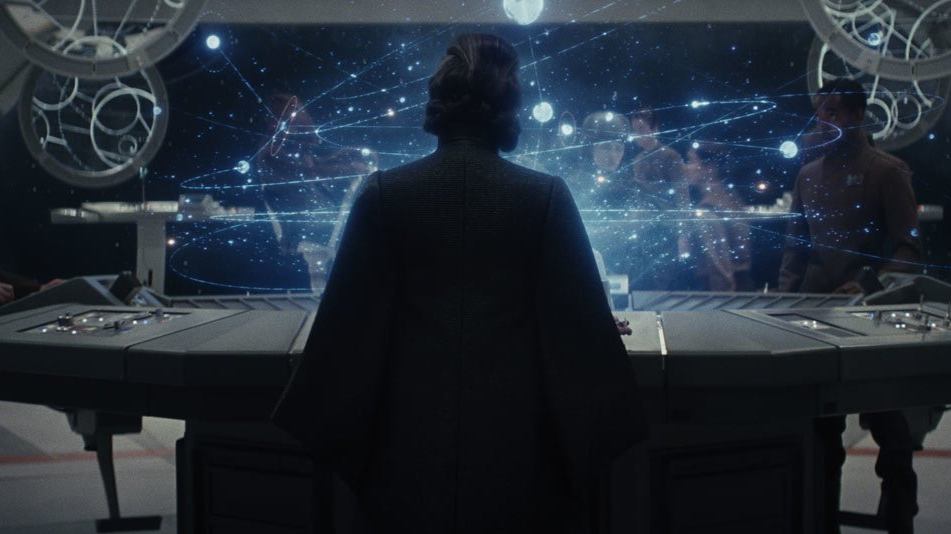
One of the clearest ways that the film allows itself to be informed by the past without mimicking or denouncing it is through the use of musical motif. While John Williams’ original soundtrack for the new films hasn’t quite established itself among the ranks of his work on the original and prequel trilogies (an incredibly high bar, for sure), what he’s been able to do most effectively is bring back old themes in ways that inspire reflection. Among the most moving examples is “Leia’s Theme,” which could always be heard as having a rich vein of mythology running through it, connecting the rebellion leader we see in the first set piece of “A New Hope” to the magical underpinnings of the galaxy far far away. “The Last Jedi” finally delivers in translating this sentiment into an awesome, sincere act that leaves a lasting impression on those who see it, both in the universe of the picture and in the audience of viewers. It provides a larger-than-life moment for a character whose ability to deliver one has been simmering beneath the onscreen action for a long time. It’s a scene that has provoked reactions ranging from glowing appreciation to outright rejection, a polarization which stands as a microcosm for the reception of the film as a whole.
Perhaps the film’s greatest achievement is the uncoupling of the saga’s high-concept thematic drive from its relentless fixation on lineage and bloodline, embracing the former and delegating the latter to specific characters. This is the realignment of Star Wars as being a populist tale, with heroes sprouting from oppression, their hope nurtured by overarching mythologies passed along from person to person across the entire galaxy. Storytelling, in this sense, is one of the greatest weapons in the fight for a more empathetic future, and Johnson’s sensitivity to this idea unites the disparate components of the movie. The Resistance standing as a symbol of hope isn’t just a slogan; it’s a reality. This knowledge elevates the stakes and pulls the fight from abstraction into terms that have tangible consequence.
“The Last Jedi” wages its own war against the expectations established by “The Force Awakens,” a nostalgic rehashing of familiar ground in the Star Wars universe. Though generally well-received at the time of its opening, “The Force Awakens” created a burdensome challenge for future installments by implicitly dictating a set of rules of the new trilogy. These rules were derived from the content and appearance of the original trilogy instead of its adherence to functional storytelling and world-building, and, as such, are more stifling than guiding. Any deviation from these rules by successive entries was inevitably going to feel jarring, so by choosing to unmoor itself from its predecessor in terms of thematic language and narrative focus, “The Last Jedi” takes a risk and opens itself up to criticism simply for being different. In doing so, it served as the catalyst that the franchise needed, but maybe not the one that some fans wanted.
“The Last Jedi” is in theaters now.
Grade: A-
 On the Image
Leave a comment