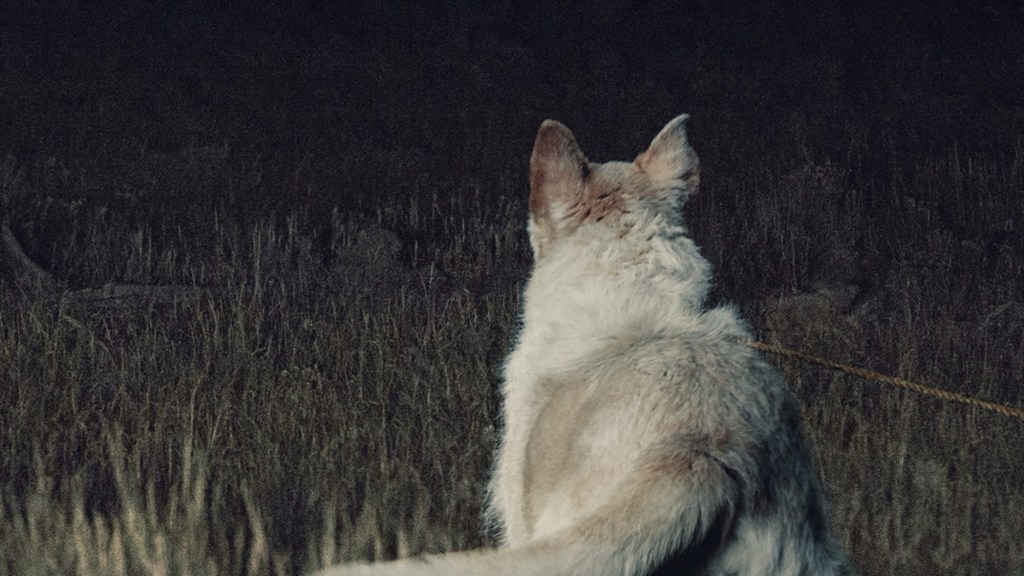
“It’s going to be okay.”
Just before nightfall, three men enter the woods, each from a different generation of one family. Bud, the oldest, is deathly ill with an unnamed plague; he will not leave the woods. Travis, the youngest, is only 17 years old; he will leave, but not as the same person. In between them is Paul, a man who grimly understands that he’s carrying a revolver and matches for a distinct reason.
One after the other, Paul uses them.
Two men now stand beside a fire. The flames seem to grow stronger as the awareness sets in that daylight is waning. The film cuts to a close-up shot of Travis, the forest imposingly reflected in the goggles of his gas mask. The reflection allows the viewer to quite literally see what Travis sees. This is a crucial cue, one that stays relevant throughout the film as the viewer spends more time with Travis and comes to form an empathetic connection with him. What, then, should the viewer make of these words, spoken by Paul to his wife Sarah only a few minutes later?
“He shouldn’t have seen that.”
“It Comes at Night,” disarmingly well-crafted by writer and director Trey Edward Shults, is a testament to the power of perspective in film. It illustrates so vibrantly the reassurance of familiarity, the vague but severe anxiety of detachment, and the terror of realizing that the two are separated by significantly less than we like to think. We as viewers become acutely aware of when we’re seeing something through the eyes of a known character and when we’re instead forced to observe events from an unknown vantage point. If we take comfort in ‘being’ Travis for much of the film, then the times that we don’t know who we are or what we’re capable of become points of grave concern. As any viewer will come to see, one of the most devastating answers to the second question is “nothing.”
Sharing in Travis’s reality grants the viewer access to his unfettered subconscious at night when he falls asleep. Horrifying, otherworldly visions of disease and death haunt his nights, and he’s confronted with imagery that taunts him by only hinting at answers to questions he doesn’t know to ask. The logic of dreams is inherent to the film’s grammar; the relation between entire sequences and reality can be confused, making viewers wonder to what side of consciousness they should look for explanations. The dreams of “It Comes at Night” offer no respite, no tangential tales of a better world, but instead they pull onlookers deeper down the rabbit hole. The link between dreams and art is even made manifest onscreen as Travis sketches pictures of figures that he has either seen awake or in his sleep. Past a certain point it’s perfectly valid to wonder if there’s any real use in maintaining a distinction between the two. I don’t think there is.
Ingrained in the film’s DNA is a prominent debt to Lars von Trier’s “Antichrist” (2009). A masterwork of modern horror, “Antichrist” centers on a couple who seeks refuge in the woods after the death of their son, where they are consumed by an irrepressible demonic violence. Its vision of the woods rages against transcendentalist optimism, as humanity is turned inside out and the devil can seemingly be found in every living thing. “It Comes at Night” draws parallels between this more abstract concept and one of a collapsed society ruled by a visceral fear rooted in the subconscious of its inhabitants.
One last note: when watching the film, you’ll notice a moment in which the camera dwells on a particularly macabre painting. It’s titled, “The Triumph of Death.”
“It Comes at Night” is in theaters now.
Grade: A
 On the Image
Leave a comment