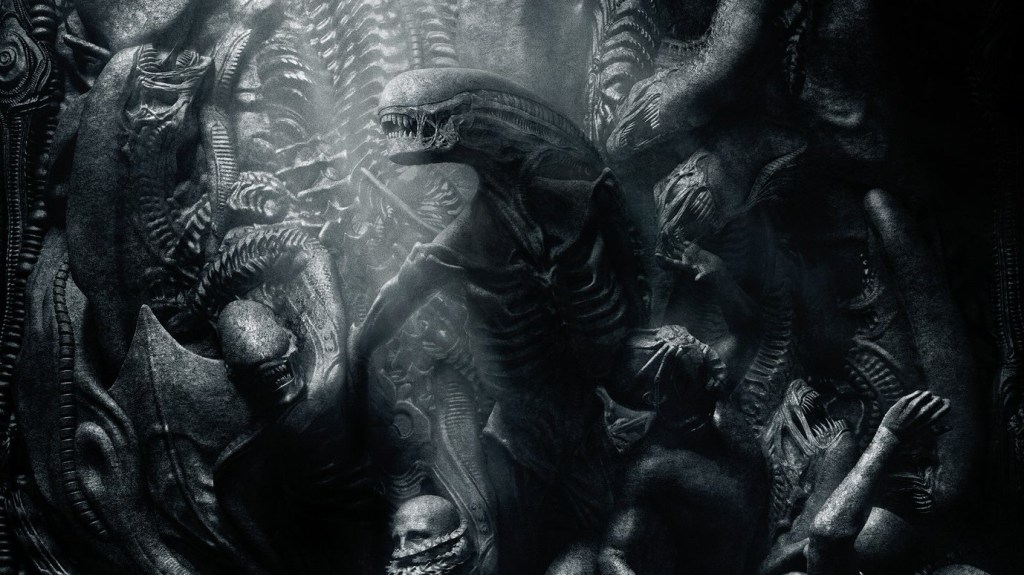
“Where do we come from?”
David (Michael Fassbender), a synthetic human, is experiencing his first moments of sentience as he finds himself next to his creator. They sit in a white room, gently tailored to accentuate each one of its contents, which include an enlarged version of Michelangelo’s “David,” a painting of the nativity scene, and a grand piano, all products and agents of human creation. This bizarre setting’s similarity to Stanley Kubrick’s vision of what lies “beyond the infinite” is striking, enough so, perhaps, to allow the situation to be read entirely allegorically. What grants this room its tenuous place in time and space, however, stems from one of its walls, comprised entirely of windows looking out into a natural expanse that appears to be untouched by human hands. This is a place for observation and contemplation, and each question posed by David’s creator is simultaneously posed to the film’s viewing audience.
“How do you feel? What do you see?”
As David sits, his chair pointed directly out towards the windows, he answers the questions by addressing only objects on his side of the glass. This is, at the least, a curious response. Consider your role as the viewer of a film; you sit in front of and directly facing a window to another world, one created by a different being than that which created you (if your faith is one that holds Ridley Scott to be the creator of all things then you can disregard this hypothetical). If you, the viewer, were to answer these questions in a similar manner, you might begin by naming the dim light fixtures in the theater, the multiple rows of seats along the shallow incline of the room, and then even your fellow moviegoers. The focus on all of this would be completely disregarding the most beautifully prominent aspect of the room: the visual portal to another world. What is Scott getting at with this peculiarity? Is it commentary on the difference between humanity and artificial intelligence within the series? Or does it perhaps let the viewer read more into David as an individual creation?
This is how Scott wants you to think about the thematic elements that he is introducing to define the new direction of the “Alien” series. It’s quite heady stuff to unpack, and initially it seems as though he is going to offer viewers a chance to parse through this dense opening sequence. The title reveal, both ominous and meditative, parallels that of the original “Alien;” the letters slowly take shape over a slow pan of the stars. This is followed by a reveal of the Covenant, a spacecraft carrying a crew of 15 members (when Scott tells viewers how many people are in a group, we know now that it’s because that number won’t remain constant for long) as well as many frozen colonists to a distant planet that is ready to be made home by way of terraforming.
To try to understand “Alien: Covenant” it is important to consider its relationship with 1979’s “Alien,” which is complicated and one that seems to take different forms depending on the perspective from which you compare the two. “Alien” is an intimate sci-fi horror picture that masterfully accomplishes everything that it intends to. It’s a movie that is defined by its minutiae. It makes enemies out of objects that twitch and dance on the peripheries of our sight, and everything seems to be perched anxiously on the edge of a bloodcurdling scream. The dread is perpetuated as much by the viewer’s apprehension as it is by the action onscreen.
“Alien: Covenant,” on the other hand has a scope that oscillates between the close-quarters terror of the original and the grandiose musings of 2012’s “Prometheus.” At this point in the series, it may seem as though the loyal viewer’s sense of adventure and discovery is gone with regards to the basic cause-and-effect systems at play. The crew members are inevitably going to come into contact with and subsequently become infected by an incredibly hostile alien species. This predictability also holds true in a moment-to-moment sense, as Scott doesn’t bother with subverting expectations, opting instead to let the viewers squirm agonizingly inside of them. The fresh aspects of the experience come about from infusing the all-too-familiar (but still largely effective) horror elements with a sense that perhaps it all means something more. Without delving too deeply into the specifics, look for symbols that contribute to discussions surrounding duality in creation and numerous other Biblical parallels.
Though the pendulum swing between the micro and macro worlds of the film is ambitious and is performed with great directorial confidence, a certain amount of dissonance seems unavoidable as the two sides of the movie don’t always play well with each other. Quiet discussions between two identical synthetic humans philosophizing over the creation of life can confuse the rigid immediacy that is so crucial to the series’ horror elements. Additionally, the dramatic irony inherent to this degree of repetition within a series can be almost comical at times (Don’t look in the egg… Of course there’s something bad in the egg!). Thankfully these issues don’t detract too much from the experience of the film, which, I suspect, largely takes place in the viewer’s mind in the days and weeks following the initial viewing.
When John Hurt’s character in “Alien” is asked what it is like to be temporarily taken over by the alien life form, he speaks only of “a horrible dream about smothering.” I’m sure audiences who sat through the film in theaters can attest to that harrowing description. In “Alien: Covenant,” when David is asked about the workings of his subconscious, he simply says, “I don’t dream at all.” Ridley Scott may not allow his creation to dream, but, with “Alien: Covenant,” he presents satisfyingly fresh ways to dream about the oldest questions.
“Alien: Covenant” is in theaters now.
Grade: B+
 On the Image
Leave a comment