There’s a lot of “Top Movies” lists out there, so I wanted to try something even more subjective and arbitrary. Below are my top 10 movie moments from films released in Oscar-year 2016.
Brief disclaimer: For whatever it’s worth, Martin Scorsese’s “Silence” and Kenneth Lonergan’s “Manchester by the Sea” have moments that would definitely be on this list but for the spoiler-filled content of those scenes.
10. Sunset Song – The End
The ending of Terence Davies’ “Sunset Song” is one that pulls its significance like a thread through the entirety of the preceding film. It involves the camera parting ways from the protagonist whom it has followed for the entire film in order to be with another central character during his final moments in World War I. It’s a tender but powerful scene that elevates the viewer’s invested experience. In combination, the deliberately slow pacing of the movie and largely secluded setting can be challenging, but this scene is so effective because it takes the prolonged, isolated feel of film and imbues that feeling with meaning. It retroactively highlights the simple beauty throughout the film by means of its present absence, and in doing so it offers viewers a chance to reevaluate their perception of everything they just experienced.
9. Jackie – The Assassination
“Jackie’s” depiction of the assassination of President John F. Kennedy is divided into several different moments that are spread throughout the course of the film, a structural choice which only begins to suggest the extent to which it was continually and excruciatingly relived by Jackie herself. The score anguishes through its sliding strings, and its resemblance to those in the horror genre seems appropriate as the memory is very much a monstrous thing that, when not being recalled, is lurking just out of sight. This darkness stands in contrast to “Jackie’s” brief respites into nature which evoke a spiritual beauty in the vein of Terrence Malick’s work, and the gulf between these two parts is key to the film’s larger discussion of mortality and grief. The film thrives in dissonance, and the constant, looming presence of the event at its heart shadows even its most pleasant moments with melancholy.
8. Don’t Breathe – Blackout
“Don’t Breathe” has one of the more novel premises for a horror film in recent memory: a small crew of thieves set out to rob an old, blind army veteran, only to find themselves trapped and hunted in his labyrinthine house. In one standout scene midway through the film, the man cuts the power in the basement, submerging the characters in complete darkness. This nod towards “Silence of the Lambs” is executed with an assured confidence and precision, and the tension it generates is wound taut until light is reintroduced. It ramps up the film’s already-white-knuckle urgency by eliminating all ambiguity in the dichotomy between the hunter and the hunted; the old man moves like a predator in his natural environment while the thieves flail about, deprived of their only advantage. The scene packs in some of the year’s most chilling imagery, including desperate close-ups of the thieves’ panicking eyes as well as a shot of an outstretched arm, reaching for any sort of guide but hovering only inches away from the hunter concealed in shadow.
7. Arrival – First Contact
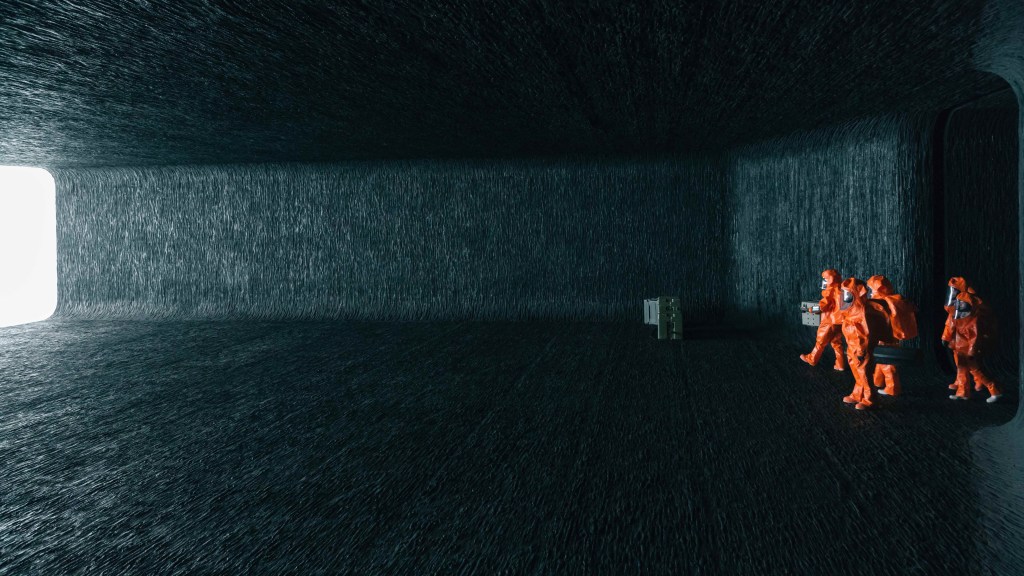
“Arrival” is a science fiction film that depicts an alien invasion on a global scale, and there are actually two closely-related moments surrounding first contact that are worth mentioning here. The first is a long, striking establishing shot that frames a UFO in a way that accentuates the sheer scale of the thing. Surrounded by the natural beauty of grassy plains and rolling clouds, the hulking ship and the military tents clustered nearby set a curious stage for the events that follow. Though cinematographer Roger Deakins did not work with director Denis Villeneuve on “Arrival,” the slow approach evokes a sense of vague dread similar to the flyover shots they orchestrated together in “Sicario.” This feeling is sustained through to the second moment, in which a small crew enters the vessel and is greeted by an empty chamber. The only lighting comes from the far end of the room, where an entire wall is replaced by a foggy window with a silver glow, allowing for a visual connection between the two species. The elegant simplicity of this presentation parallels the design of a movie theater and places the viewer immediately in the presence of the scientists and translators as they try to communicate with the alien lifeforms. “Arrival” is at its best when it plays on the strengths of this iconic set piece.
6. Hail, Caesar! – No Dames
Five minutes of a Coen-led tribute to Gene Kelly-era musicals featuring Channing Tatum is proof that there is innate goodness in the world. The scene starts as a film within a film, a 1950’s tap number incorporating elements of various musicals including “On the Town” and “Singin’ in the Rain,” and it only intermittently breaks from that commitment to show Josh Brolin’s character handling some business backstage. This is appropriate in a larger sense as “Hail, Caesar!” is itself structured similarly to “Singin’ in the Rain,” from its portrayal of Hollywood behind the curtains to the use of its title existing as a separate picture within the picture. I don’t have a lot to say about this scene besides that I love it and everyone else should too.
5. Swiss Army Man – The Beginning
Known to many as “the farting corpse movie,” “Swiss Army Man” finds itself well-behind the eight ball from its opening shot, and it may reasonably have quite a ways to go to capture a viewer’s heart. Considering this, the film’s first five minutes are essentially make or break, as it has to effectively convince its audience that a buddy-adventure-movie featuring Paul Dano as a stranded survivor and Daniel Radcliffe as a barely animated corpse can make for an entertaining two hours. The opening scene is bookended by a man pushed to the brink of his life by helpless isolation and then that very same man riding a corpse like a jet ski, propelled by its flatulence. Despite the less-than-pleasant nature of its subject matter, everything comes together in a wonderfully constructed introduction. It combines a diegetic soundtrack with a backing a cappella accompaniment that organically builds to emotional heights, and at its peak the title text triumphantly bursts across the screen. Somehow this movie works, and it’s in large part due to this scene’s ability to turn skeptical viewers into believers.
4. Hacksaw Ridge – The Ridge
For better or for worse, “Hacksaw Ridge” was one of my more memorable viewing experiences in 2016. While I feel there are legitimate discussions to be had involving its willingness to try a viewer’s suspension of disbelief as well as the seeming abandonment of its humanist outlook in the final act, for the sake of this list I want to give credit to its sickeningly effective portrayal of the first foray over the ridge. “Hacksaw Ridge” is delivered in distinct parts, and the scene at the ridge takes full structural advantage of this decision. The film’s opening stretch goes to great lengths to illustrate the sanctity of every human life and that preserving and protecting life is an inherent good. It then proceeds to run that worldview, held dearly by its protagonist played by Andrew Garfield, through a messy gauntlet of contradictions presented by its boot camp sequence which is very much made in the mold of first half of Stanley Kubrick’s “Full Metal Jacket.” The ideals persist, however, and the viewer may even dare to feel cautiously optimistic about what lies ahead. Then, without much in the way of a transition, the viewer follows US troops into battle, and what follows is a staggeringly brutal sequence in which human lives end at an alarming rate. Masterfully edited and viscerally horrifying, every single sight and sound works to depict decades more of human experience being swiftly and senselessly destroyed. Despite the inconsistency of what follows, there weren’t many moments as impactful all year.
3. Neon Demon – Runway
In Nicolas Winding Refn’s “Neon Demon,” the internal transformation of Jesse, the protagonist played by Elle Fanning, occurs largely within the confines of a single visually stunning sequence. Despite her passivity in the film’s opening acts, she is selected for a prominent modeling role in a prestigious designer’s show. In shooting this set piece, Refn does away with any of the viewer’s preconceptions of how a runway scene should or could be composed and instead opts for something completely alien. Equal parts mystifying and enthralling, the 4 minute runway scene invokes a Kubrickian air, and is more than vaguely reminiscent of the “Beyond the Infinite” montage in “2001: A Space Odyssey.” It is a succinct distillation of Refn’s cinematographic preferences; it toys with symmetry and interjects symbolism through imagery that is stark, vivid, and dense. The soundtrack marches in lockstep with the visuals, as composer Cliff Martinez has continually worked with Refn over the years and knows exactly how to harness the power of scenes that may tend towards overindulgence. Few films in 2016 were as polarizing as “Neon Demon,” but few worked with a vision as singular and startling, and this is epitomized by the few minutes on the runway.
2. A Bigger Splash – “Emotional Rescue”
“A Bigger Splash” is built on the collective efforts of its excellent ensemble cast, but in one sequence Ralph Fiennes manages to steal the entire movie. His character (Harry Hawkes) tries desperately to reunite with his one true love, whom he feels that he mistakenly gave up earlier in life, and through an interesting bit of performance art he makes that desire plainly apparent. Set to the Rolling Stones’ “Emotional Rescue,” the scene comes to own the song to the point where it’s difficult to disassociate afterwards; its music and movement (of the camera, the cuts, and the characters) are seamlessly synchronized. Fiennes’ infectious energy is on full display, as he dances around the room, stealing the attention of everyone in attendance and pulling them into his performance. He disappears and reemerges from behind a curtain and enters into a brief, insane walk where he both is and isn’t staring directly into the camera. The whole thing culminates in Harry dancing by himself, lost in his own head. What starts as an act that appears freeing and joyously animated becomes strangely claustrophobic and tortured. Then, before the song is through, the scene is brought to an abrupt, jarring end.
1. La La Land – The Planetarium
Musicals are largely underpinned by the idea that some emotions are too powerful for words to properly communicate, and that we can instead turn to song and dance as means of elevated expression. Likewise, movies are unmoored from the bounds of realism, and the concept of the movie musical is at its best when these two realizations intersect. “La La Land’s” dance at the planetarium derives its power from being entirely true and exclusive to the medium, and it cements the film as a musical that is created for the silver screen, not simply adapted onto it. The scene begins by mirroring a shot from “Rebel Without a Cause” (previously featured in the film) and proceeds to pay homage to filmically diverse influences ranging from Andrei Tarkovsky to Baz Luhrmann. The delicate build-up to the climax is slow and sweet, and it contains an interesting element that is key to how the scene functions; Sebastian and Mia (Ryan Gosling and Emma Stone) seem to adopt a sort of cinematic self-awareness. Right after a handkerchief suddenly floats into the air out of Sebastian’s hand, both characters pause and share brief moments of astonished eye contact with the camera. However, any air of uncertainty quickly subsides, as Sebastian lifts Mia upward with purpose and sends her into a gentle levitation before joining her among the stars. The resulting dance and resolution feels effortlessly transcendent, and together it stands as one of the defining moments of the year in film.

 On the Image
Leave a comment